Sản phẩm và dịch vụ bảo tồn nước

trang chủ > Các sản phẩm >Dữ liệu vệ tinh > Sản phẩm và dịch vụ bảo tồn nước

Sản phẩm và dịch vụ bảo tồn nước

For the full coverage of remote sensing data of Jilin-1 satellite and high revisit ability, it can timely monitor the construction of water conservancy facilities, dam and reservoir bank safety

Chia sẻ:
SỰ MIÊU TẢ

tham số

Digital twin river basin standardized data base plate

Water regulation

DOM Data Backboard

Establishment, revision and updating of reservoir capacity curve

DEM/DSM Data Baseboard

Irrigation area monitoring and water consumption calculation by remote sensing


Flood and drought disaster monitoring services


tham số

River basin flood control project construction monitoring

River and lake supervision (river and lake chief system management)

Situation of Reservoir construction

River and lake sand mining planning

Safety of dam and reservoir bank

River and lake remote sensing feature interpretation

The construction of flood storage area

Investigation of prominent problems hindering river flood flow

River channels and beware of construction

Planning for the protection of key river banks and shorelines


"Normalize and standardize" the four disordered areas in Qing Dynasty


The boundary data of shoreline spatial control of river and lake management waters are dynamically updated


tham số

Soil and water conservation supervision

Supervision of water environment and water ecology

Soil and Water Conservation

Bloom monitoring

Disturbance supervision

Outfall monitoring


Cage fish culture

tham số

Marine regulation


Coastlines, reefs and beaches monitoring


Fishery resources Monitoring


Enteromorpha and red tide monitoring


Marine Disaster Warning


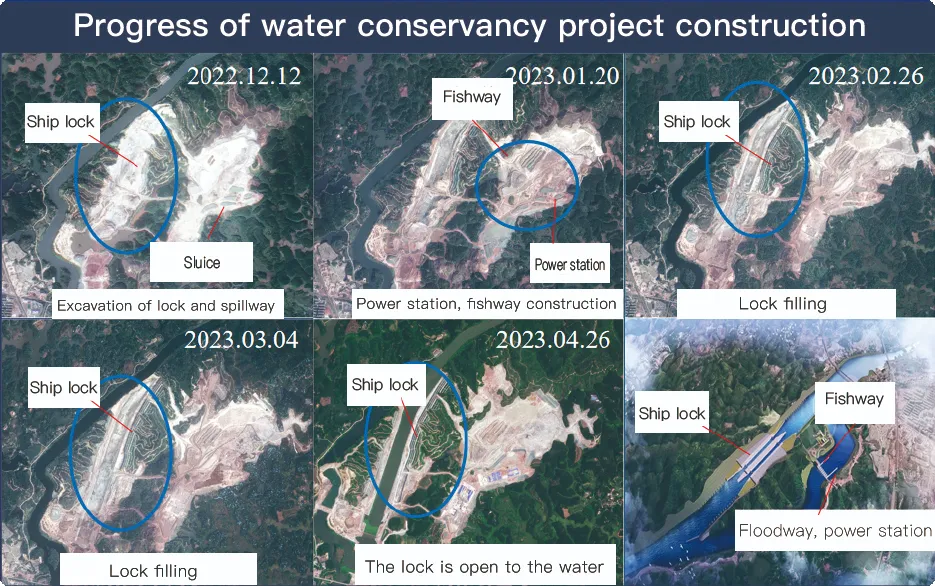
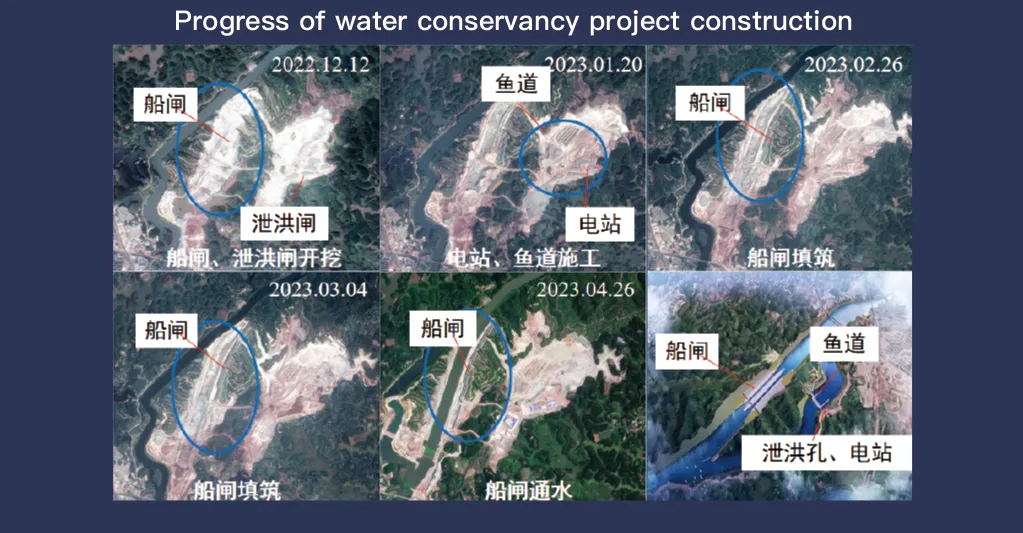
Application Of Monitoring The Construction Of Water Conservancy Facilities


For the full coverage of remote sensing data of Jilin-1 satellite and high revisit ability, it can timely monitor the construction of water conservancy facilities, dam and reservoir bank safety, flood storage area construction, river and guard construction, etc., assist the water conservancy department in the construction and management of water conservancy projects, improve the construction quality of water conservancy projects, and comprehensively understand the progress of the project.
 

Read More About spatial resolution


Hệ thống vệ tinh Jilin-1, được biết đến với phạm vi bao phủ toàn bộ dữ liệu cảm biến từ xa và khả năng tái hiện cao, đóng vai trò quan trọng trong việc giám sát và quản lý các cơ sở bảo tồn nước. Công nghệ hình ảnh tiên tiến của hệ thống cho phép quan sát cơ sở hạ tầng như đập, hồ chứa, hệ thống thủy lợi và bờ sông với độ phân giải cao, thời gian thực, cung cấp dữ liệu thiết yếu để theo dõi tiến độ xây dựng, đánh giá tính toàn vẹn của kết cấu và phát hiện rủi ro sớm.


Với khả năng xem lại tần suất cao, Jilin-1 có thể liên tục chụp và cập nhật hình ảnh các vị trí mục tiêu, đảm bảo phát hiện kịp thời những thay đổi về mực nước, độ ổn định của đất và các điểm yếu tiềm ẩn về cấu trúc. Khả năng này đặc biệt có giá trị đối với công tác phòng chống thiên tai, vì nó cho phép các cơ quan chức năng xác định các rủi ro như lở đất, xói mòn đập và nguy cơ lũ lụt trước khi chúng leo thang.


Moreover, the satellite’s multi-spectral and high-resolution imaging enhances the ability to monitor environmental conditions around water conservancy projects, such as vegetation cover, sedimentation, and water pollution levels. This data supports decision-making for sustainable water resource management and climate adaptation strategies.


By integrating Jilin-1 remote sensing data with geographic information systems (GIS) and artificial intelligence, real-time monitoring and predictive analysis can be further enhanced, improving response efficiency and safety measures. The satellite’s capability to provide accurate and timely data reduces reliance on ground inspections, lowering operational costs and improving the overall resilience of water conservancy infrastructure. Thus, Jilin-1 serves as a powerful tool for governments, environmental agencies, and engineering firms to ensure the safety and efficiency of water-related projects.

data acquisition

environmental data

land cover change

spatial resolution

water pollution detection
data acquisition

environmental data

land cover change

spatial resolution

water pollution detection

Looking for reliable water conservancy solutions?

Fill out the inquiry form below, and we will provide the best products and services for your needs!

Liên hệ với chúng tôi

Radar Altimeter Satellite in Water Resource Monitoring


Effective water management increasingly depends on accurate, continuous, and wide-scale data collection. A radar altimeter satellite plays a crucial role by measuring variations in surface elevation over oceans, rivers, and reservoirs. These instruments detect even small fluctuations in water levels, which directly affect flood forecasting, irrigation scheduling, and long-term planning for hydropower generation. Unlike ground-based sensors, satellites provide consistent global coverage, reducing blind spots in monitoring networks.


The technology behind an altimeter satellite allows for millimeter-level precision in tracking height changes. For water conservancy agencies, this means improved understanding of seasonal variations in river discharge and reservoir capacity. Such measurements are essential for balancing competing needs—urban supply, agricultural irrigation, and ecosystem protection. By integrating these datasets into hydrological models, authorities can make proactive decisions that minimize the risks of water scarcity or flooding.


A central technique in this field is radar altimetry, which transmits microwave pulses toward the Earth’s surface and measures the time it takes for them to return. When applied to water surfaces, this process provides continuous elevation profiles. Over time, the accumulation of such data reveals patterns of climate-driven variability and supports early warning systems for extreme weather events.


Recent advances in satellite radar altimeter design have further expanded applications in water conservancy. Improved instruments now operate across wider frequency ranges, reducing signal loss in complex terrains and increasing accuracy over inland water bodies. Combined with high-resolution remote sensing satellites, these altimeters contribute to integrated water information systems that benefit policy makers, engineers, and researchers alike.


The adoption of radar altimetry in water conservancy is about more than data—it is about resilience. By leveraging these satellite-based tools, water managers gain foresight into challenges that were once difficult to anticipate, ensuring that communities remain protected and resources are used sustainably.


Altimeter Satellite Applications in Water Conservancy


Modern water conservancy requires reliable data for decision-making, and an altimeter satellite has become one of the most valuable tools in this process. These satellites help monitor surface water levels in rivers, lakes, and reservoirs on a large scale, ensuring that water distribution and flood control strategies are based on accurate, timely information.


In flood-prone regions, the combination of radar altimetry and hydrological modeling provides early warnings that ground sensors alone cannot achieve. By detecting unusual rises in river levels, authorities can issue alerts well before critical thresholds are reached. This integration of satellite observations into early-warning systems greatly reduces human and economic losses during extreme events.


Reservoir management is another area where satellite radar altimeter technology makes a difference. Operators can use satellite-derived measurements to optimize dam releases, balance power generation with irrigation demands, and ensure downstream safety. In arid regions, these measurements support fair allocation of limited resources by offering transparent, independent data sources.


An important advantage of a radar altimeter satellite is its ability to collect information across vast and inaccessible regions. Mountain reservoirs, remote wetlands, and transboundary rivers can all be monitored without extensive on-ground infrastructure. This capability strengthens international cooperation in shared water basins by providing consistent, unbiased datasets that every party can rely on.


As climate change continues to affect rainfall patterns and water availability, these applications become even more critical. Reliable satellite data ensures that adaptive strategies—whether for irrigation scheduling, flood mitigation, or water supply planning—are supported by evidence rather than estimates. By integrating altimetry into everyday water conservancy operations, governments and organizations are better prepared to face long-term sustainability challenges.


Future of Radar Altimetry in Water Management


The advancement of radar altimetry has transformed how researchers and decision-makers observe and manage global water resources. As new missions are launched, satellites are becoming more precise, allowing water surface elevation to be tracked with centimeter-level accuracy. This shift enables the detection of subtle seasonal changes that directly affect irrigation planning, navigation safety, and groundwater recharge strategies.


Next-generation altimeter satellite systems are designed to operate in multiple frequency bands. This multi-frequency approach helps reduce errors caused by atmospheric disturbances and surface roughness, ensuring that data remain consistent across varying climatic conditions. Such improvements are particularly valuable in regions with complex hydrology, such as deltaic zones or snow-fed river systems.


The integration of satellite radar altimeter observations with optical and hyperspectral imagery offers new possibilities for water quality monitoring. While altimetry provides elevation data, other sensors can capture turbidity, sediment load, and chlorophyll concentration. Combined, these datasets create a holistic picture of water systems that supports sustainable management policies.


Moreover, radar altimeter satellite technologies are increasingly linked with real-time data platforms. Through cloud-based analytics, governments, researchers, and even local water authorities can access up-to-date water level measurements without the delay of traditional data processing. This democratization of information accelerates response times during droughts or floods and fosters better regional cooperation.


In the near future, innovations such as constellations of small satellites equipped with compact altimeters may complement larger missions. This shift would increase observation frequency, providing near-daily updates instead of relying solely on long-repeat-orbit satellites. Such high-temporal-resolution data could transform water conservancy from a reactive to a predictive discipline.

Innovative Water Conservancy Solutions

Sản phẩm liên quan
Tin tức liên quan

Nếu bạn quan tâm đến sản phẩm của chúng tôi, bạn có thể để lại thông tin tại đây và chúng tôi sẽ sớm liên hệ với bạn.