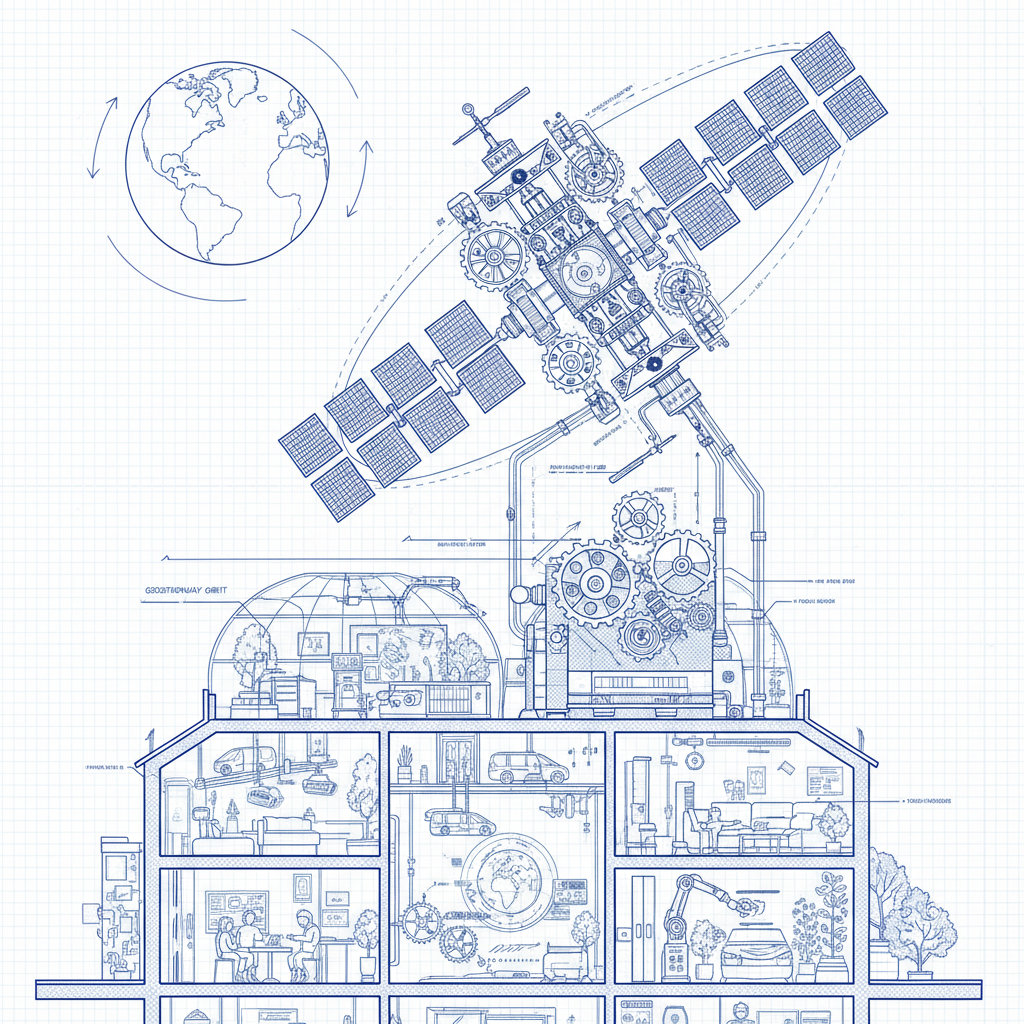
In the rapidly evolving sector of aerospace engineering, the quest for high-efficiency power sources has led to the development of space-level perovskite solar cells. While technical specifications are critical, the ability to visualize these complex systems through precise image rendering allows engineers and stakeholders to understand the physical integration of calcium-titanium-mineral arrays into satellite chassis. This synthesis of cutting-edge material science and visual clarity is essential for ensuring mission success in the vacuum of space.
The global transition toward sustainable space exploration requires components that can withstand extreme thermal cycling and ionizing radiation. By utilizing image rendering to model the deployment of flexible solar arrays, designers can predict mechanical stresses and optimize the photoelectric conversion efficiency—which reaches up to 23.9% for single-junction cells—before a single prototype is launched. This approach reduces cost and minimizes the risk of failure in deep-space missions.
Ultimately, the integration of Space-Level Calcium-Titanium-Mineral Solar Cells represents a leap in power-to-weight ratios, with rigid cells weighing only 0.8kg/m2. Through advanced image rendering, the industry can now standardize the visual documentation of these components, ensuring that every solar cell, from monolithic 50mm×50mm units to stacked perovskite structures, is positioned for maximum energy absorption across various orbital orientations.
The Role of Visualization in Space-Level Solar Cell Design
The design of space-level photovoltaic systems requires an unprecedented level of precision. Using high-fidelity image rendering, engineers can simulate how 50mm×50mm monolithic solar cells interact with the spacecraft's structural components. This allows for the optimization of the "Degradable silver-clad busbar" and the overall layout to ensure that no shadows are cast during critical orbital maneuvers.
Moreover, these visual simulations provide a bridge between theoretical material science and practical assembly. By applying realistic lighting and texture mapping in their image rendering processes, teams can better assess the thermal radiation properties of the calcium-titanium-mineral surfaces, ensuring that the cells maintain their function within the working temperature range of -100℃ to +110℃.
Technical Specifications and Photoelectric Efficiency
At the heart of the Space-Level Calcium-Titanium-Mineral Solar Cell is its impressive photoelectric conversion efficiency. Single junction cells achieve 23.9% efficiency under AM0 (Air Mass Zero) conditions, while maintaining 22.7% under AM1.5. This high efficiency is critical for satellites with limited surface area, allowing them to generate maximum power for onboard instruments and communication arrays.
The structural precision is equally noteworthy, with a standard monolithic size of 50mm×50mm. This modularity allows for the creation of large-scale arrays that can be tailored to the specific power needs of a mission, whether it be a small CubeSat or a complex deep-space exploration probe. The use of advanced semiconductor materials ensures that these cells capture a broader spectrum of solar energy.
Weight reduction is another primary driver of this technology. Rigid perovskite solar cells weigh approximately 0.8kg/m2, but the flexible variants drop this further to 0.5kg/m2. This weight saving is pivotal in the aerospace industry, where every gram of mass added to a launch vehicle increases the cost and complexity of the mission.
Resilience Against Extreme Space Environments
Space is one of the most hostile environments known to man, characterized by extreme temperature swings. To ensure reliability, these solar cells undergo rigorous high and low temperature impact tests ranging from -90℃ to +90℃. Through image rendering of thermal stress maps, developers can identify potential failure points in the cell's crystalline structure.
The durability is further proven by a heating rate of 20℃/min over 500 impact cycles. This process mimics the rapid transition from the cold shadow of the Earth to direct solar exposure. The stability of the calcium-titanium-mineral composition ensures that the photoelectric properties do not degrade prematurely under these punishing conditions.
Beyond thermal stress, the ground-based aging process uses high and low temperature cycling to simulate years of orbital life. By combining this empirical data with advanced image rendering of material degradation, scientists can predict the end-of-life efficiency of the arrays, ensuring that the satellite remains powered throughout its intended operational lifespan.
Comparing Perovskite Solar Cell Architectures
Depending on the mission requirements, different architectures are employed. The Single Junction Calcium-titanium-mineral Solar Cell is the standard for balanced performance, offering 23.9% efficiency. In contrast, the Stacked Perovskite Solar Cell pushes the boundaries further, reaching an efficiency of 24.5% by layering materials to capture more photons.
These differences are often visualized using image rendering to show the internal layer stacking. The stacked approach allows for a higher voltage output, which is particularly beneficial for power controllers in complex satellite subsystems.
Performance Comparison of Perovskite Solar Cell Architectures
Flexible Integration and PI Membrane Design
The introduction of Flexible Perovskite Solar Cells has revolutionized the deployment of power systems on UAVs and small satellites. These cells feature a PI (polyimide) membrane integrated design, allowing the array to adapt to 180° full-angle bending. This flexibility is critical for "Folding and Unfolding Mechanisms" that must fit into tight launch fairings.
To validate these designs, engineers use image rendering to simulate high bending stress. This ensures that the flexible substrate does not crack and that the electrical connectivity remains stable even after repeated deployment cycles. The resulting weight of 0.5kg/m2 makes these cells the gold standard for lightweight aerospace power.
Radiation Hardening and Electron Irradiation Tests
Cosmic radiation is a primary cause of degradation for satellite components. The Space-Level Calcium-Titanium-Mineral Solar Cell is specifically engineered to be resistant to proton and electron irradiation. Tests conducted under 1MeV and 3×10¹⁴e/cm2 irradiation demonstrate the robustness of the material.
One of the most impressive findings is the recovery capability of the cells. After irradiation, annealing under AM0 irradiation for 24 hours allows the efficiency to stabilize, only decreasing slightly from 23.9% to 22.8%. This minimal loss ensures long-term operational stability in high-radiation orbits.
Through detailed image rendering of the crystal lattice, researchers can observe how the calcium-titanium-mineral structure prevents the formation of deep-level defects caused by high-energy particles, effectively "hardening" the cell against the space environment.
Future Trajectory of Calcium-Titanium-Mineral Technology
Looking ahead, the synergy between material science and digital twins will redefine how we build satellites. The use of image rendering will transition from mere visualization to real-time simulation, where live telemetry data from orbiting cells informs the design of the next generation of stacked perovskites.
We anticipate further reductions in weight and increases in efficiency as the integration of PI membranes becomes more seamless. The goal is to create "skin-like" power systems that wrap around the entire chassis of a spacecraft, maximizing every available square centimeter for energy harvest.
As we push toward deep space exploration, the reliability of these solar cells—proven by their ability to survive -100℃ to +110℃—will be the cornerstone of autonomous power systems. The continued evolution of calcium-titanium-mineral technology promises a future of indefinite power for the farthest reaches of our solar system.
Analysis of Space-Level Solar Cell Performance Metrics
| Cell Type |
Max Efficiency |
Weight (kg/m2) |
Radiation Stability |
| Single Junction |
23.9% |
0.8 |
High (22.8% post-rad) |
| Stacked Perovskite |
24.5% |
0.85 |
Very High |
| Flexible Perovskite |
23.0% |
0.5 |
Moderate-High |
| Standard Rigid |
22.0% |
0.9 |
Moderate |
| PI Membrane Integrated |
23.2% |
0.55 |
High |
| Deep Space Variant |
24.0% |
0.7 |
Extreme High |
FAQS
The primary advantages are the significantly higher power-to-weight ratio and superior radiation resistance. With rigid cells at 0.8kg/m2 and efficiencies up to 23.9%, they provide more power with less mass than traditional space-grade silicon, while maintaining stability after 1MeV electron irradiation.
The flexible cells utilize a PI membrane integrated design that allows for 180° full-angle bending. This ensures that the cell can be folded tightly for launch and unfolded in orbit without compromising the structural integrity or the photoelectric conversion efficiency.
Under conditions of 3×10¹⁴e/cm2 irradiation, the efficiency may drop slightly (e.g., from 23.9% to 22.8%). However, these cells are designed for recovery; annealing under AM0 irradiation for 24 hours helps restore and stabilize the conversion efficiency.
Yes, they are engineered for a wide working temperature range from -100℃ to +110℃. They have undergone rigorous thermal impact tests between -90℃ and +90℃ to ensure they can handle the rapid temperature fluctuations typical of satellite orbits.
Single junction cells are standard high-efficiency units (23.9%). Stacked perovskite cells layer multiple materials to capture a wider range of the solar spectrum, resulting in a higher peak efficiency of 24.5%, making them ideal for high-power missions.
The silver-clad busbar is designed to provide high electrical conductivity while managing the thermal expansion and contraction of the cell. Its specific design prevents delamination during the extreme temperature cycling experienced in space.
Conclusion
The development of Space-Level Calcium-Titanium-Mineral Solar Cells represents a pivotal shift in aerospace energy. By combining high conversion efficiencies (up to 24.5%) with extreme radiation hardness and lightweight flexible designs, these cells address the most critical challenges of satellite power generation. The integration of precise image rendering into the design phase ensures that these complex materials are deployed with maximum efficacy and reliability.
As we move toward a new era of interplanetary exploration and dense satellite constellations, the reliance on such robust, lightweight, and efficient power sources will only grow. We recommend that mission architects prioritize the adoption of flexible perovskite arrays to optimize launch mass and power longevity. To learn more about our cutting-edge satellite components, visit our website: www.space-navi.com.