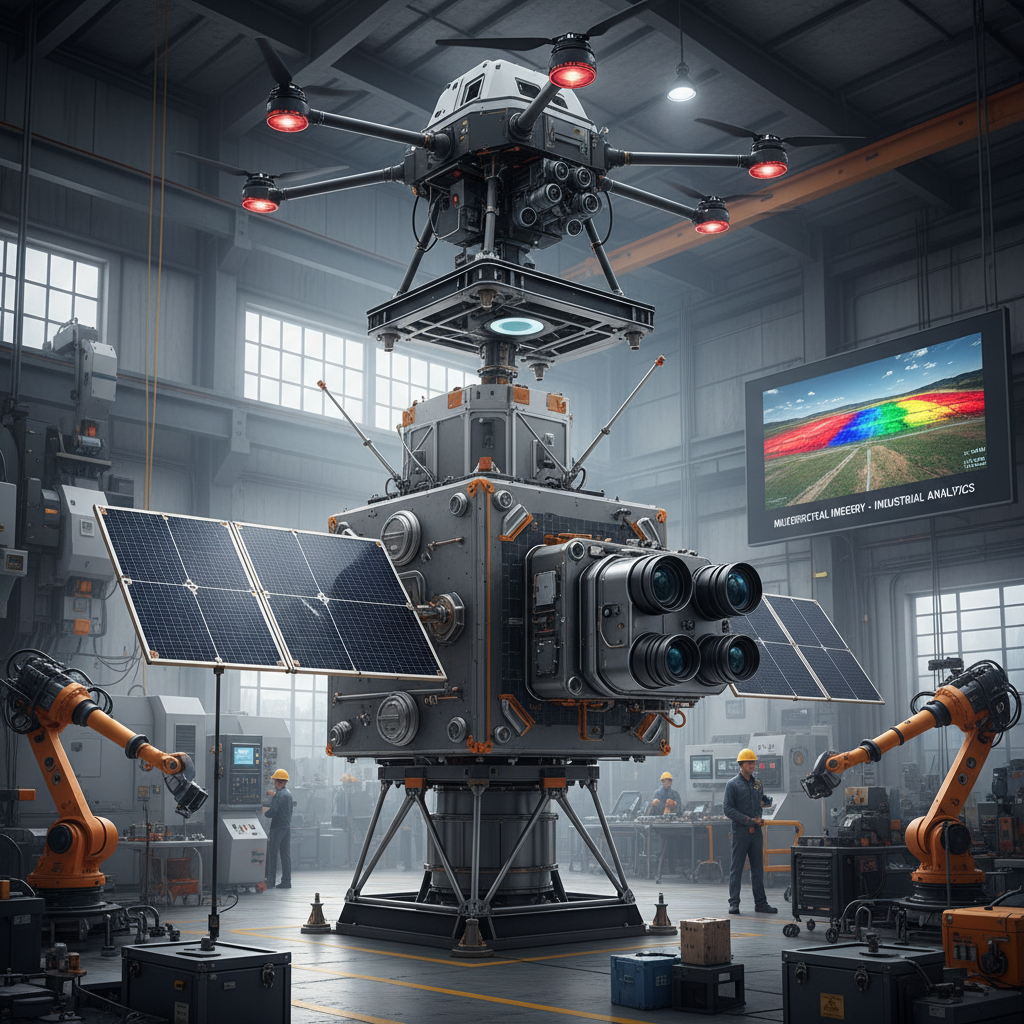
In the high-stakes realm of aerospace engineering, the ability to capture, process, and analyze real-time telemetry is the difference between mission success and catastrophic failure. A sophisticated data acquisition system serves as the nervous system of any satellite or spacecraft, translating raw physical phenomena—such as thermal fluctuations, vibration, and voltage swings—into actionable digital intelligence. As we push further into deep space and deploy more complex satellite constellations, the demand for precision and reliability in these systems has never been higher.
Globally, the integration of advanced sensing technologies is driving a revolution in how we monitor orbital assets. From monitoring the efficiency of Calcium-titanium-mineral Solar Arrays to ensuring the structural integrity of folding mechanisms, the data acquisition system provides the critical feedback loop required for autonomous adjustments and ground-based diagnostics. Without high-fidelity data, the operational risks associated with extreme temperature cycling and cosmic radiation would be insurmountable for modern aerospace ventures.
Understanding the nuances of these systems allows engineers to optimize power sub-systems, refine TT&C (Telemetry, Tracking, and Command) products, and enhance the lifespan of space-level components. By leveraging high-speed sampling and radiation-hardened circuitry, a robust data acquisition system ensures that every watt of energy generated by Gallium Arsenide cells is accounted for and every mechanical movement is validated, securing the future of interplanetary exploration and global communication.
Global Industry Context of Data Acquisition Systems
The global aerospace sector is currently witnessing an unprecedented surge in satellite deployments, with thousands of SmallSats and CubeSats entering Low Earth Orbit (LEO). This expansion has placed immense pressure on the hardware used for monitoring; the industry is shifting toward highly integrated, low-power data acquisition system architectures that can handle massive streams of sensor data without draining the limited power provided by solar arrays.
According to standards aligned with ISO and aerospace quality benchmarks, the reliability of telemetry data is paramount. The primary challenge lies in the "harsh environment" variable—where extreme thermal cycling (from -100°C to +110°C) and high-energy particle radiation can induce bit-flips or hardware degradation. This makes the development of radiation-hardened acquisition systems not just a luxury, but a fundamental requirement for mission continuity.
Defining the Modern Data Acquisition System
At its simplest level, a data acquisition system (DAQ) is a process used to collect information from various sensors—such as thermocouples, accelerometers, and pressure transducers—and convert those analog signals into digital values that can be processed by a computer. In the context of aerospace, this involves high-precision Analog-to-Digital Converters (ADCs) and sophisticated signal conditioning to ensure that noise from the satellite's power system does not corrupt the critical data.
Beyond simple measurement, these systems are intrinsically linked to the survival of the spacecraft. For instance, when monitoring a Space-Level Calcium-Titanium-Mineral Solar Cell, the DAQ must precisely track the photoelectric conversion efficiency under varying AM0 irradiation levels. This connection between raw electricity generation and digital monitoring allows ground control to assess the health of the power sub-system in real-time.
Modern DAQs have evolved from bulky, standalone units into embedded, modular components integrated directly into the satellite's bus. This evolution supports the humanitarian and scientific needs of the modern age, enabling more accurate weather forecasting, global connectivity through UAVs and satellites, and the precise monitoring of environmental changes from orbit.
Core Components for Space-Grade Reliability
The first pillar of a professional data acquisition system is Signal Conditioning. In the vacuum of space, sensors often produce very weak signals that are susceptible to electromagnetic interference. High-grade amplifiers and filters are employed to clean the signal before it reaches the converter, ensuring that the data reflecting the performance of a Lithium Battery Pack or an Optical Camera is accurate and noise-free.
Radiation Hardening is the most critical differentiator for aerospace applications. A standard data acquisition system used on Earth would fail quickly due to Single Event Effects (SEE) caused by cosmic rays. Space-grade systems utilize specialized semiconductor materials and redundant circuitry (Triple Modular Redundancy) to ensure that a single particle strike does not result in a system crash or corrupted telemetry.
Finally, Scalability and Integration allow these systems to grow with the mission's complexity. Whether monitoring a simple antenna product or a complex folding and unfolding mechanism, the system must support a variable number of channels. By utilizing a modular architecture, engineers can add more sensor inputs without redesigning the entire power controller or data bus, significantly reducing development costs and time-to-launch.
Practical Applications in Satellite Infrastructure
In real-world satellite operations, the data acquisition system is deployed across multiple subsystems. For example, in the deployment of solar arrays, the DAQ monitors the current and voltage output of Calcium-titanium-mineral solar cells during the unfolding process. This ensures that the folding and unfolding mechanism has functioned correctly and that the cells are achieving their rated 23.9% efficiency under AM0 conditions.
Furthermore, these systems are indispensable for the health monitoring of Lithium Battery Packs and Power Controllers. By tracking charge/discharge cycles and thermal gradients, the system can predict potential failures before they occur, allowing operators to switch to redundant power paths. This application is particularly vital for deep-space probes where manual repair is impossible and autonomous reliability is the only option.
Performance Efficiency of Different DAQ Architectures
Tangible Advantages and Long-Term Value
The primary advantage of implementing a high-fidelity data acquisition system is the drastic reduction in operational risk. By providing a transparent view of the satellite's internal state, operators can move from "reactive" maintenance to "predictive" management. This shift not only extends the operational life of the satellite but also ensures the safety of high-value instruments and optical cameras during critical mission phases.
Beyond the technical metrics, there is a profound logical and emotional value in the trust these systems provide. When a multi-million dollar satellite is launched, the confidence of the stakeholders depends on the reliability of the telemetry. Knowing that every sensor—from the power sub-system to the TT&C products—is being monitored by a precise DAQ provides the peace of mind necessary to push the boundaries of aerospace innovation.
Future Innovations in Aerospace Data Capture
The next generation of data acquisition system technology is leaning heavily toward the integration of Artificial Intelligence at the edge. By processing data directly on the spacecraft rather than transmitting raw streams back to Earth, "Edge-DAQ" can identify anomalies in real-time and trigger autonomous corrective actions. This reduces the bandwidth load on TT&C products and allows for faster responses to emergency events.
We are also seeing a move toward "Smart Materials" acting as sensors. Imagine a folding mechanism where the structural material itself acts as a strain gauge, feeding data directly into the data acquisition system. This would eliminate the need for separate sensors, reducing the overall weight—a critical factor when dealing with payloads where every gram counts.
Furthermore, the synergy between DAQs and next-gen photovoltaics, like the flexible perovskite solar cells, will allow for more dynamic energy harvesting. Future systems will be able to correlate the 180° bending stress of flexible arrays with their real-time efficiency, optimizing the orientation of the satellite to maximize power intake automatically.
Overcoming Technical Challenges in Data Acquisition
One of the most persistent challenges in any data acquisition system is the trade-off between sampling speed and power consumption. High-frequency sampling is necessary to capture transient vibrations during launch, but it drains the battery rapidly. The solution lies in "Adaptive Sampling," where the system remains in a low-power state and only triggers high-speed acquisition when a specific threshold is crossed.
Another hurdle is thermal management. In a vacuum, heat can only be dissipated through conduction and radiation. DAQ components can overheat during intense processing tasks, leading to signal drift. Advanced thermal interface materials and integration with the satellite's passive cooling systems are essential to maintain the accuracy of the converted digital data.
Finally, the "Data Deluge" problem—where the volume of collected data exceeds the transmission capacity of the satellite—requires innovative compression algorithms. By implementing lossless compression within the data acquisition system, engineers can maximize the amount of telemetry sent back to ground stations without losing the critical details required for analysis.
Comparative Analysis of Data Acquisition Strategies for Aerospace Components
| Monitoring Target |
DAQ Priority |
Critical Metric |
Reliability Score |
| Perovskite Solar Cells |
Efficiency Tracking |
Conversion % @ AM0 |
9.5 |
| Folding Mechanisms |
Positional Accuracy |
Deployment Angle |
8.8 |
| Lithium Battery Packs |
Thermal Stability |
Cell Temp Gradient |
9.2 |
| Optical Camera Mounts |
Vibration Analysis |
G-force Peak |
8.5 |
| Power Controllers |
Voltage Regulation |
Ripple Voltage |
9.7 |
| TT&C Antennas |
Signal Integrity |
SNR Ratio |
9.0 |
FAQS
The primary role is to collect raw analog data from various onboard sensors—such as temperature, voltage, and pressure—and convert it into digital telemetry. This allows ground controllers to monitor the health of the spacecraft, verify the deployment of components like solar arrays, and make real-time adjustments to the satellite's orientation or power distribution to ensure mission longevity.
Cosmic radiation can cause "Single Event Upsets" (SEUs), which are essentially random bit-flips in the system's memory or processor. This can lead to corrupted data readings or total system crashes. To combat this, space-grade DAQs use radiation-hardened components and redundant logic paths to detect and correct these errors automatically, maintaining data integrity.
Yes, a modern DAQ is essential for monitoring flexible perovskite solar cells. It tracks how the cell's efficiency changes under different bending stresses (up to 180°) and thermal cycles. By analyzing the correlation between physical deformation and power output, engineers can optimize the deployment of flexible arrays for maximum energy absorption.
While a standard DAQ is designed for controlled laboratory environments, a space-level DAQ is engineered for extremes. This includes a wider operating temperature range (-100°C to +110°C), radiation hardening to prevent electronic failure, and rigorous weight optimization to minimize launch costs, all while maintaining extreme precision in signal conversion.
During launch, DAQs often use "high-speed burst mode" to capture rapid vibrations and G-forces. To manage the volume, they utilize onboard buffers and sophisticated data compression algorithms. Some systems only save data when certain "trigger" events occur, ensuring that the most critical telemetry is preserved without overloading the storage or transmission links.
While the physical hardware cannot be changed, many modern DAQs are designed with "reconfigurable" FPGAs (Field Programmable Gate Arrays). This allows engineers to upload new firmware from the ground, effectively updating the data processing algorithms, sampling rates, or filtering logic to adapt to new mission requirements or fix bugs.
Conclusion
The data acquisition system stands as the critical link between the physical realities of space and the digital intelligence required to master it. From the meticulous tracking of photoelectric conversion in perovskite solar cells to the rigorous monitoring of satellite power controllers, these systems ensure that every mission is backed by accurate, reliable, and timely data. By integrating radiation hardening, adaptive sampling, and modular architectures, the aerospace industry can push the boundaries of exploration with confidence.
Looking forward, the convergence of Edge AI and smart sensing will transform DAQs from passive recorders into active decision-makers. As we venture toward the Moon and Mars, the ability to autonomously process and react to telemetry will be the cornerstone of deep-space autonomy. We encourage aerospace engineers and procurement specialists to prioritize high-reliability acquisition frameworks to safeguard their orbital investments. Visit our website for more professional solutions: www.space-navi.com