The core goal of the standard platform is to meet diverse mission requirements with minimal modifications, where the modularity and reconfigurability of each component are crucial. Below are the key design drivers for the design and verification of the standard platform:
• (a) Compatibility with various mission payloads developed recently;
• (b) Reusability in educational satellites developed by universities;
• (c) Maximizing the reuse of hardware and software;
• (d) Optimizing weight (lighter) and space (larger volume) compared to traditional platforms;
• (e) Equipped with high-reliability interfaces;
• (f) Shortening the production cycle of FM (Flight Model);
• (g) Reducing the workload of AIT (Assembly, Integration, and Test).
To achieve the above design drivers, the standard platform adopts the following core solutions:
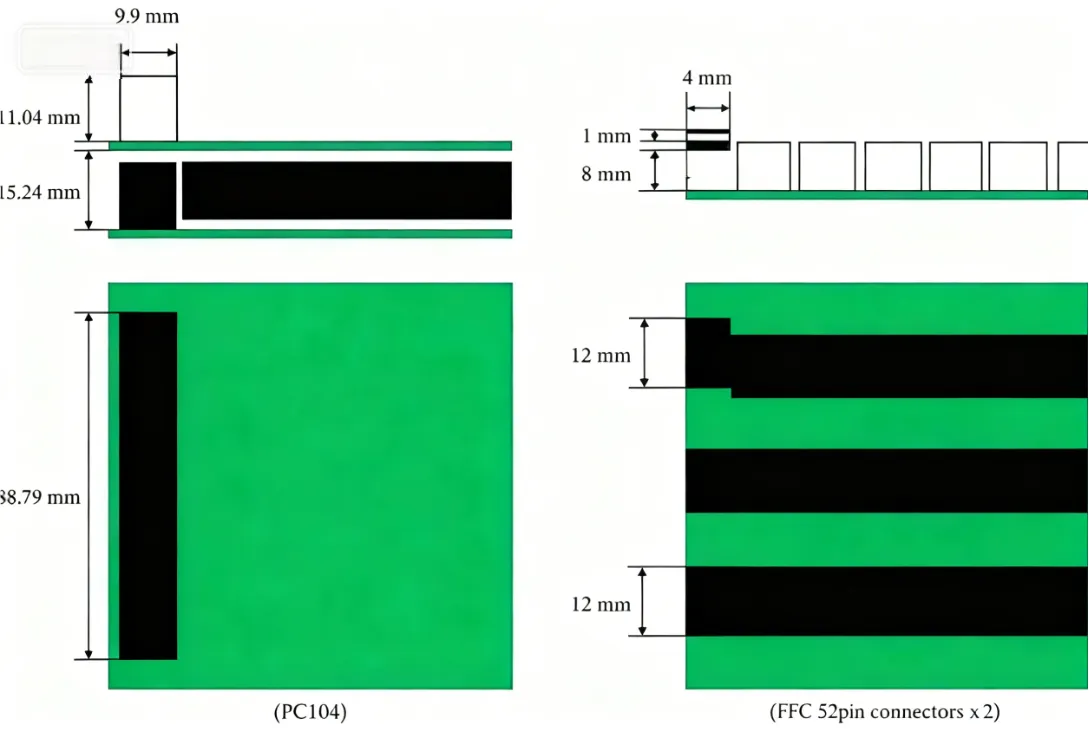
PC104 is the most commonly used interface in current CubeSat kits. Since early CubeSats originated from PC104, most developers use it as the bus interface. The advantage of PC104 lies in its ability to construct load paths in the vertical direction of printed circuit boards (PCBs), avoiding the concentration of physical loads on the boards and facilitating mechanical connection and assembly. However, with the diversification of satellite functions, multiple types of interfaces are required. PC104 has insufficient scalability, occupies large space, and has low utilization efficiency.
Figure 1 Comparison of space occupied by PC104 and FFC.
Therefore, the standard platform developed in this research uses FFC connectors instead of PC104 to reduce connection space and weight (Figure 2 shows the space comparison between PC104 and FFC). A set of PC104 weighs approximately 25g, while two FFC connectors weigh only 0.11g; if a satellite contains 10 boards, the total mass of PC104 connectors reaches 250g, compared to only 1.1g for FFC connectors. However, each contact point of PC104 allows a current of 3A, while FFC connectors only allow 0.2A, making them unsuitable for power transmission. Therefore, a dedicated connector is used for satellite power supply through an LCL (Latching Current Limiter) switch. Currently, PC104 is mostly used for signal lines, and a separate connector is required for power transmission. It can be seen that FFC has more advantages over PC104 in terms of space (volume) and mass.
I2C has long been used as an interface for small satellites but suffers from a hang-up issue with low reliability—when the system malfunctions, hang-ups can easily lead to the paralysis of the entire system. Additionally, I2C is a single-ended system with weak anti-interference capability and no fault-tolerant communication protocol. In small spaces with multiple EMI (Electromagnetic Interference) sources, it is more significantly affected by noise.
To address the shortcomings of I2C, two interfaces—CAN (Controller Area Network) and SpaceWire—are being considered in the small satellite field. Both have reliability comparable to interfaces used in large satellites. However, the IP (Intellectual Property) cost of SpaceWire is relatively high, making it unsuitable for CubeSats when balancing cost and reliability. Therefore, the standard platform uses CAN as the main bus.
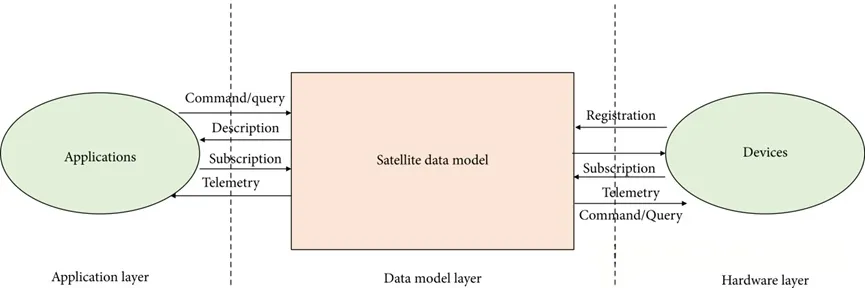
The platform developed in this research applies basic plug-and-play technology, which enables automatic detection, registration, and identification of components, processing of command/response messages, data distribution and subscription, fault identification, and system monitoring. Even if components are replaced, this technology can automatically identify component interfaces, accelerate the interface recognition speed between components, and promote system integration when only the physical interface is known in advance.
Figure 2 Concept of plug-and-play.
At the hardware level, data is collected based on the satellite data model (Figure 2); at the application level, data is retrieved by accessing the satellite data model. Even if the application program changes, mission applications and various subsystem applications can be easily configured (Figure 2 is a schematic diagram of the plug-and-play concept).