The standard platform is based on an optimized lightweight and modular design to reduce the overall development cost and cycle of the satellite. This design only requires the development and modification of modules related to payload development and interface changes for different missions.
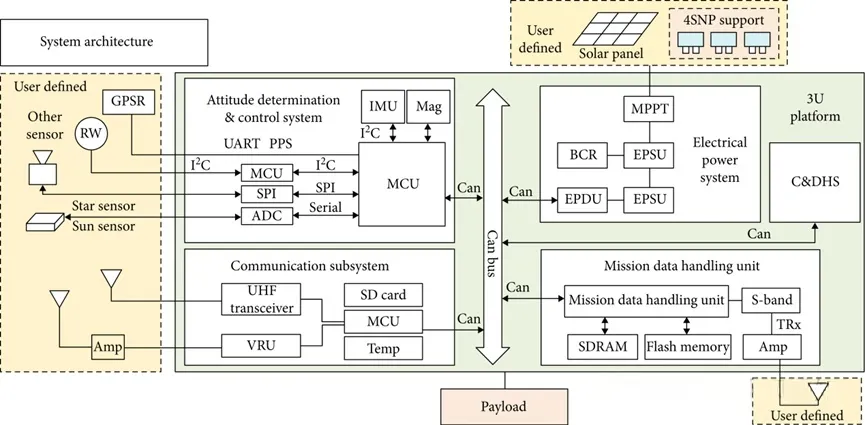
To meet the requirements, the standard platform architecture basically covers all necessary subsystems and reserves space for future expansion. The main subsystems of the standard platform are as follows:
• (a) SMS (Structure and Mechanism Subsystem);
• (b) ADCS (Attitude Determination and Control Subsystem);
• (c) C&DHS (Command and Data Handling Subsystem);
• (d) EPS (Electrical Power Subsystem);
• (e) CS (Communication Subsystem);
• (f) MDHS (Mission Data Handling Subsystem);
• (g) TCS (Thermal Control Subsystem).
The standard platform implements two interfaces—I2C and CAN (both widely used in existing microsatellites)—to ensure interoperability with currently commercially available products. These interfaces support M2M (Machine-to-Machine) communication, allowing users to flexibly expand the number of components according to their needs. The platform is equipped with a mission data processor for payloads, independent data storage interfaces, and an S-band communication system for mission data transmission, minimizing the interfaces between the platform and payloads. Users can independently configure the actuators and sensors for CubeSat attitude control; the solar panels, batteries, and mechanical devices of the electrical power subsystem can also be flexibly set by users (see the figure for the system architecture of the standard platform).
System Architecture of the Standard Platform.