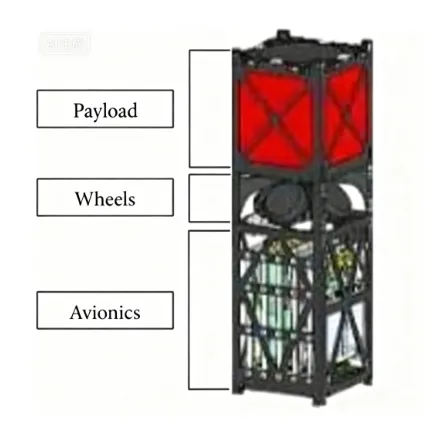
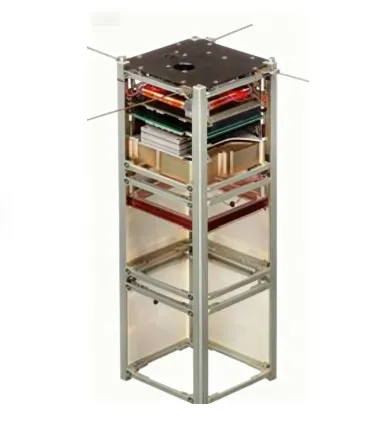
In recent years, driven by the widespread application of 3U CubeSats, CubeSat startups such as Pumpkin, NanoAvionics, and Clyde Space, as well as several universities, have been developing 3U CubeSat platforms and subsystem modules to promote commercialization. Among them, the platform developed by PEARL (PEARL External Atmospheric Research Laboratory) adopts a 1.5U bus platform, a 0.5U reaction wheel, and a 1U payload; NanoAvionics has developed and commercialized the 3U platform PLT3 (Figure 1 shows the platform configurations of PEARL and PLT3).
Figure 1 3U CubeSat platforms. (a) PEARL (b) PLT3
In satellite development projects, research on standard platforms is extensive. Enterprises such as Airbus, Boeing, Lockheed Martin, and NEC sell medium and large satellite buses, enabling easy payload integration through standard platforms; the next-generation compact satellite being developed by the Korea Aerospace Research Institute (KARI) also adopts a standard platform. Reusing standard platforms can reduce satellite development difficulty and ensure system reliability through standardized electrical and mechanical interfaces.
The shape of CubeSats is significantly influenced by the operating mode and deployment configuration of solar panels. There are three main deployment configurations for 3U CubeSat solar panels: 1) Solar panels attached to the surface of the satellite structure; 2) Deployment from the side edges of the satellite (diagonal deployment type); 3) Deployment from the top edges (Figure 2). The All-Star/THEIA solar panels developed by the Space Technology Acceleration and Research Laboratory (STAR Lab) achieve higher power generation efficiency than traditional shapes due to their edge deployment design, but they face a higher probability of defects and deployment failures caused by vibrations during launch. The VELOX-1 satellite developed by Nanyang Technological University adopts a common approach, deploying four solar panels—though with lower power efficiency, it features a simple structure, stable development, and a low failure rate (Figure 2(b)). The solar panels of the Lemur-1 satellite are attached to the side panels, avoiding deployment issues but resulting in lower power efficiency due to the limited number of panels (Figure 2(c)).
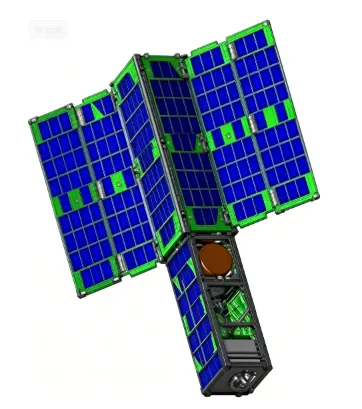
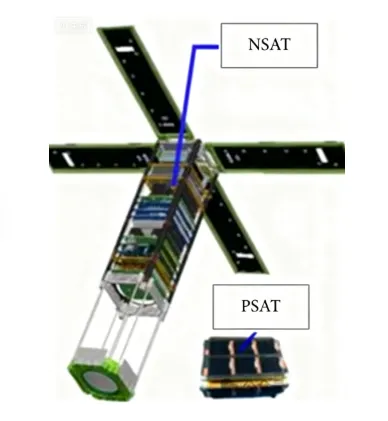
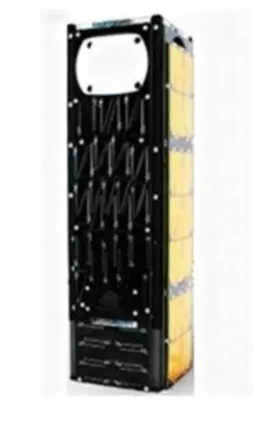
Figure 2 Solar array deployment configurations. (a) All-Star/THEIA. (b) VELOX-1. (c) Lemur-1.
This research aims to design and develop an efficient, reusable, and scalable 3U CubeSat standard platform. During the design process, specifications and configurations of the standard platform were determined by referencing the specifications of currently operational 3U CubeSats, further clarifying the configuration, functions, and performance of a universal 3U standard platform that can minimize satellite development effort and duration. Based on this standard platform, the research team developed KAUSAT-5, whose reliability was verified through functional/performance tests and environmental tests. Launched in January 2018, KAUSAT-5 was used to validate the core technology of the small satellite VSCMG (Variable Speed Control Moment Gyroscope) developed by the Space Systems Research Laboratory at Korea Aerospace University, for Earth observation and radiation measurement.