The Unified S-Band (USB) Aerospace Tracking, Telemetry and Command (TT&C) Network refers to a microwave unified TT&C system operating in the S-band. Here, the microwave unified TT&C system is a radio TT&C system that integrates functions such as spacecraft tracking and orbit determination, telemetry, telecommand, and space-ground communication through a shared radio frequency (RF) channel.
The basic working principle of the microwave unified system is as follows: various types of information are first modulated separately onto subcarriers of different frequencies; these modulated subcarriers are then summed and jointly modulated onto a single carrier for transmission. At the receiving end, the carrier is first demodulated, followed by filtering to separate the individual subcarriers using frequency-specific filters. Finally, each subcarrier signal is demodulated to retrieve the original information transmitted.
A typical microwave unified TT&C system generally consists of the following components: an antenna tracking/angle measurement system, a transmission system, a reception system, a telemetry terminal, a telecommand terminal, a ranging/velocity measurement terminal, a time/frequency terminal, a monitoring and control system, remote monitoring or data transmission equipment, and other auxiliary devices.
The USB Aerospace TT&C Network was first deployed by the United States in the 1960s for the Apollo Moon Landing Program. In the early 1960s, during the Mercury and Gemini manned space missions, the U.S. used multi-band equipment to perform distinct tasks independently. This resulted in numerous antennas on the spacecraft, leading to excessive weight, poor reliability, and the need for highly complex ground-based support equipment. To address these issues, the National Aeronautics and Space Administration (NASA) proposed adopting a unified S-band (2000–4000 MHz) system as the ground support infrastructure for the Apollo program. By the mid-1960s, a tracking and TT&C network centered on the USB system was established, marking a shift in aerospace TT&C from a decentralized, single-function architecture to an integrated, multi-functional one.
The operational principle of USB aerospace TT&C is relatively straightforward. The spacecraft to be measured is classified as a cooperative target, as opposed to a non-cooperative target such as an enemy missile. A cooperative target actively collaborates with the ground TT&C system. All spacecraft requiring TT&C services are equipped with at least one transponder operating in the S-band. When distance and azimuth measurements are needed, a ground USB TT&C station transmits a set of pseudo-random codes to the spacecraft. Upon receiving these codes, the on-board transponder immediately relays them back to the ground station. The USB station calculates the distance to the spacecraft based on the round-trip signal time; the angular position of the spacecraft is determined using the azimuth and elevation angles of the ground station’s antenna.
The aforementioned functions represent only one of the three core capabilities of the USB system—tracking and orbit determination. The USB equipment also integrates two additional key functions:
- Telecommand: It can send control commands, clock synchronization data, various operational parameters, and even perform remote software upgrades to the spacecraft.
- Telemetry: It can receive a wide range of data reports, images, and video streams transmitted from the spacecraft.
In essence, an aerospace TT&C system is a communication system with auto-adjustable antenna orientation. Its complexity is significantly lower than that of radar systems, and its construction cost is correspondingly much cheaper. This cost-effectiveness makes it economically feasible to build a global network of TT&C stations, enabling seamless coverage of all satellite orbits and laying the foundation for the commercialization of the aerospace TT&C industry.
The USB system comprises four core technical elements:
- Unified Carrier Wave: Tracking, telemetry, and telecommand signals are modulated onto a single carrier via multiple subcarriers. This greatly simplifies on-board equipment, reduces payload weight, and eliminates electromagnetic compatibility issues caused by multiple independent devices.
- S-Band Operation: Utilizing the S-band enhances communication range and measurement accuracy, while also satisfying requirements for electromagnetic compatibility and wide bandwidth.
- Phase-Locked Loop (PLL) Technology: Adopts PLL technology invented in the 1950s for stable signal processing.
- Pseudo-Random Code Ranging: Employs pseudo-random code-based ranging to solve the challenge of measuring distances of up to 380,000 km to spacecraft in lunar orbit.
In the decades that followed, the unified band TT&C architecture was gradually adopted by major aerospace powers worldwide, becoming a de facto international standard. Beyond the S-band, this architecture has been extended to other frequency bands, including L-band (1–2 GHz), C-band (4–8 GHz), and X-band (8–12 GHz). The first extension was to the C-band, resulting in the Unified C-Band (UCB) system. These different frequency bands can adapt to the radio regulations of various countries, provide varying bandwidths, and exhibit distinct radio signal propagation characteristics. Systems operating in different bands can share the same set of antennas, enabling multi-band aerospace TT&C stations to provide TT&C services for the vast majority of satellites.
- The S-band features the lowest cosmic noise among relevant frequency bands.
- Frequency range: 2025–2300 MHz.
- The USB TT&C system has two channels: an uplink and a downlink. The uplink and downlink carrier frequencies are coherent and follow a fixed transponder ratio of 221:240. The uplink frequency range is 2025–2110 MHz, and the downlink frequency range is 2200–2300 MHz. Both the uplink and downlink carriers adopt a residual carrier modulation scheme, specifically a Phase Modulation (PM) approach.
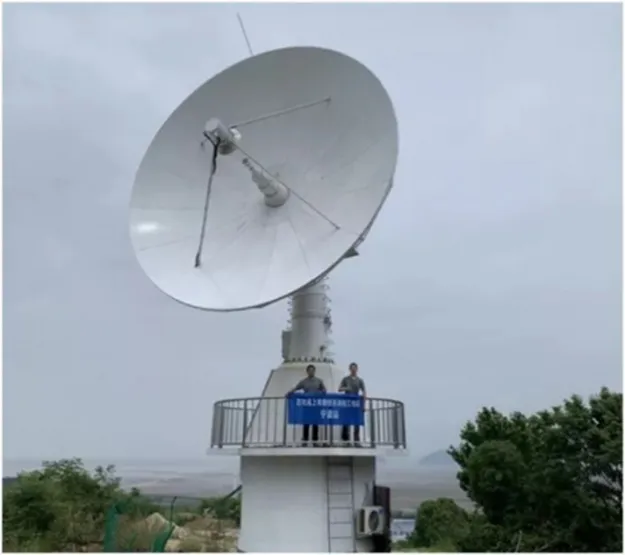
The external appearance of a typical unified band TT&C station is illustrated in the figure below.
The USB TT&C and communication system is not suitable for micro/nanosatellites. The use of multiple subcarriers and secondary modulation would drastically increase the volume of on-board equipment and power consumption—requirements that are incompatible with the small size, light weight, and low power budgets of micro/nanosatellites. Therefore, micro/nanosatellites require alternative approaches to integrate TT&C and communication functions that align with their inherent characteristics.
The Consultative Committee for Space Data Systems (CCSDS) “Advanced Orbiting Systems (AOS)” adopts the concept of virtual channels. Data from different sources (orbit determination, telemetry, telecommand, communication, etc.) with varying data rates and application processes are standardized into fixed-length Virtual Channel Data Units (VCDUs) through packetization and labeling. These VCDUs are then time-division multiplexed (TDM) onto a single physical channel for transmission using appropriate multiplexing scheduling algorithms.
Compared to the subcarrier-based approach of USB, the virtual channel method uses only a single modulation step, reducing equipment complexity and power requirements. Furthermore, through time-division multiplexing and channel labeling, it achieves the integration of TT&C and communication functions, making it highly suitable for the TT&C and communication needs of micro/nanosatellites.