
- Afrikaans
- Albanian
- Amharic
- Arabic
- Armenian
- Azerbaijani
- Basque
- Belarusian
- Bengali
- Bosnian
- Bulgarian
- Catalan
- Cebuano
- China
- Corsican
- Croatian
- Czech
- Danish
- Dutch
- English
- Esperanto
- Estonian
- Finnish
- French
- Frisian
- Galician
- Georgian
- German
- Greek
- Gujarati
- Haitian Creole
- hausa
- hawaiian
- Hebrew
- Hindi
- Miao
- Hungarian
- Icelandic
- igbo
- Indonesian
- irish
- Italian
- Japanese
- Javanese
- Kannada
- kazakh
- Khmer
- Rwandese
- Korean
- Kurdish
- Kyrgyz
- Lao
- Latin
- Latvian
- Lithuanian
- Luxembourgish
- Macedonian
- Malgashi
- Malay
- Malayalam
- Maltese
- Maori
- Marathi
- Mongolian
- Myanmar
- Nepali
- Norwegian
- Norwegian
- Occitan
- Pashto
- Persian
- Polish
- Portuguese
- Punjabi
- Romanian
- Russian
- Samoan
- Scottish Gaelic
- Serbian
- Sesotho
- Shona
- Sindhi
- Sinhala
- Slovak
- Slovenian
- Somali
- Spanish
- Sundanese
- Swahili
- Swedish
- Tagalog
- Tajik
- Tamil
- Tatar
- Telugu
- Thai
- Turkish
- Turkmen
- Ukrainian
- Urdu
- Uighur
- Uzbek
- Vietnamese
- Welsh
- Bantu
- Yiddish
- Yoruba
- Zulu
LEO Satellite Power and Energy System: Technical Selection and Cost Analysis of the Core Power Source
Introduction
Energy is the lifeline of Low Earth Orbit (LEO) satellites, and the reliability of the power and energy system directly determines a satellite’s on-orbit operational lifetime and mission execution capability. As a key subsystem accounting for 10%–15% of the total satellite cost, its technical selection must balance efficiency, weight and cost, making it an unignorable core link in commercial aerospace projects. This paper elaborates on the composition, technical routes and cost logic of the power and energy system.
I. Core Components: Three Modules Constructing a Stable Power Chain
The LEO satellite power and energy system consists of three parts: the solar cell array, energy storage battery system, and power control and management system, which jointly provide full-process power support for solar energy collection - electrical energy storage - intelligent distribution:
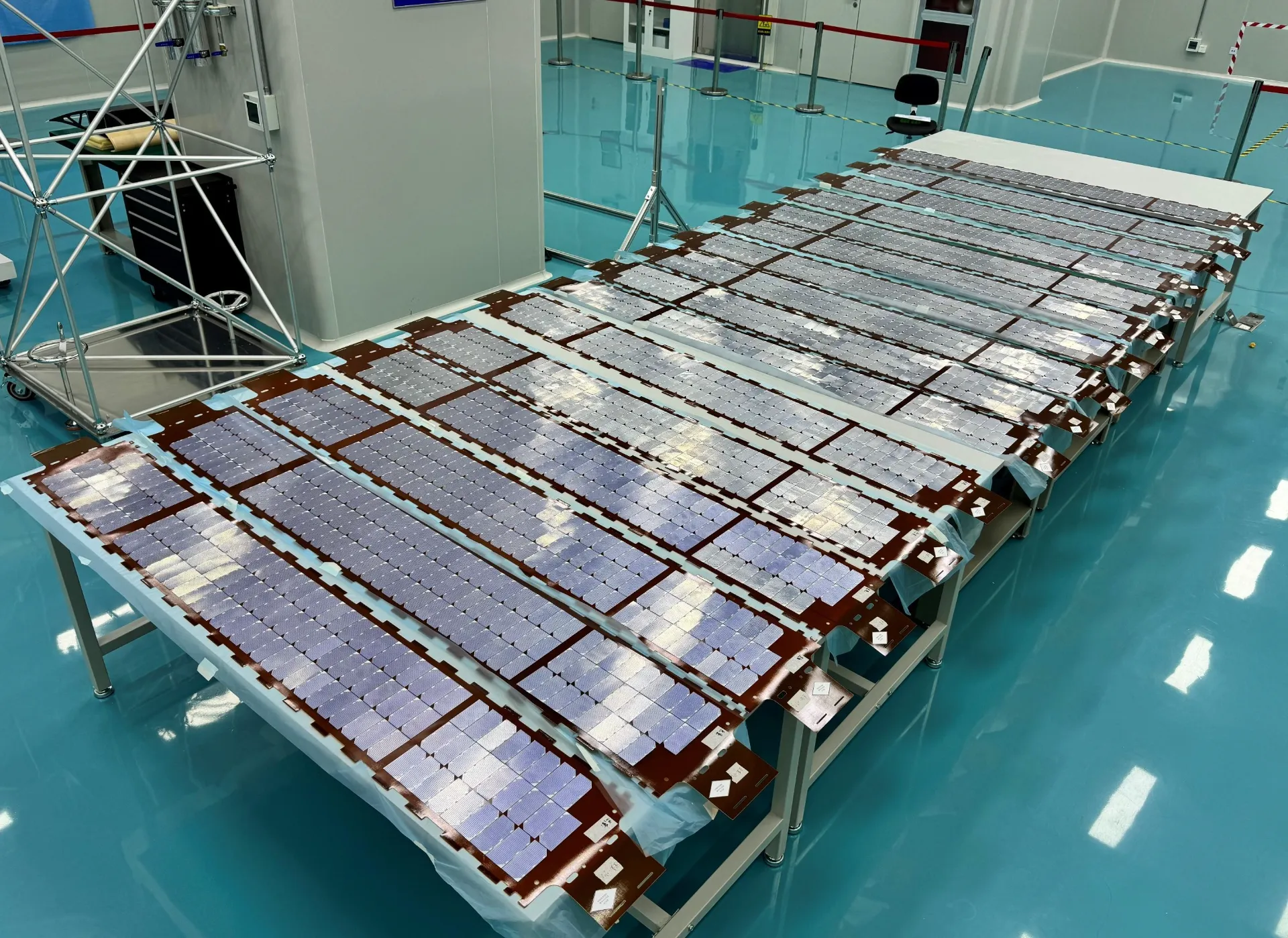
1. Solar Cell Array: The Collector of Space Energy
The solar cell array is the primary energy source of a satellite, responsible for converting solar energy into electrical energy. The current mainstream technical routes include:
- Triple-junction gallium arsenide (GaInP/GaAs/Ge) batteries: The first choice for high-value communication satellites, with a photoelectric conversion efficiency of over 30%. Starlink V2.0 Mini adopts this type of battery, assembled into a large-area array to meet the power demand of the 790kg satellite.
- Crystalline silicon (Si/P-type HJT) batteries: A core option for cost reduction in commercial aerospace, featuring lower cost but slightly lower efficiency, and is regaining popularity in the LEO satellite market.
- Cadmium telluride (CdTe) and perovskite solar cells: Emerging technologies with a conversion efficiency of 23%–30%, expected to become alternative solutions in the future.
The solar cell array accounts for 50%–60% of the power system cost, ranging from 1 to 1.5 million RMB. The cost difference mainly stems from battery type, area, efficiency and reliability requirements—gallium arsenide batteries offer high efficiency but high manufacturing costs, while crystalline silicon batteries require a larger area to compensate for lower efficiency.
2. Energy Storage Battery System: The Power Backup for Shadow Zones
When a satellite enters the Earth’s shadow zone or cannot receive solar energy, the energy storage battery system must provide stable power supply. The core requirements for LEO satellite energy storage batteries include: high energy density (storing more energy within limited weight and volume), long cycle life (supporting on-orbit operation for more than 10 years with over 15,000 cycles), radiation resistance and extreme temperature adaptability (-40℃ to 60℃).
Lithium-ion batteries have become the current mainstream choice due to mature technology and high energy density. The high-performance lithium-ion batteries equipped on Starlink V2.0 Mini can ensure stable power supply for the satellite under all operating conditions. This part accounts for 30%–40% of the power system cost, ranging from 0.6 to 1 million RMB, mainly depending on battery capacity and reliability grade.
3. Power Control and Management System: The Intelligent Hub for Electrical Energy Distribution
This system is responsible for electrical energy distribution and charge-discharge control, ensuring seamless switching between solar power generation and energy storage. Its core components include:
- Power Control Unit (PCU): Realizes Maximum Power Point Tracking (MPPT) of the solar cell array and battery charge control.
- Power Distribution Unit (PDU): Distributes power to each subsystem with over-voltage and over-current protection functions.
- Battery Management System (BMS): Monitors battery parameters such as voltage, current and temperature.
- Charge-discharge controller: Implements intelligent charge-discharge management to avoid battery damage caused by over-charging and over-discharging.
The cost of the power control and management system ranges from 0.3 to 0.5 million RMB, accounting for 15%–20% of the power system cost. Its manufacturing cost reflects the technical complexity and reliability requirements of power control in the space environment.
II. Technical Trends: Efficiency Improvement and Cost Optimization Proceed in Parallel
1. Efficiency Upgrading: Continuous Breakthroughs in New Battery Technologies
The conversion efficiency of triple-junction gallium arsenide batteries is still rising, expected to exceed 35% in the next 3–5 years; the stability and radiation resistance of emerging technologies such as perovskite batteries are being researched and developed. If their space application is realized, the weight and cost of the power and energy system will be significantly reduced.
2. Cost Optimization: Scale and Localization as the Core Paths
With the expansion of mass production scale of commercial aerospace satellites, the procurement costs of solar cells and energy storage batteries will drop significantly; at the same time, the technical maturity of domestic gallium arsenide batteries and lithium-ion batteries is constantly improving, with the self-sufficiency rate of key components rising from 60% to over 90%, which can effectively avoid cost fluctuations caused by import dependence.
3. Integrated Design: Enhancing System Reliability
The integration level of the power control and management system is constantly improving. Modular design reduces the number of components, lowers the risk of failure, simplifies the assembly process and further compresses manufacturing costs.
III. Industrial Value: The Power and Energy System is the Foundation of Long-Life and High-Reliability Satellites
For LEO satellites, the performance of the power and energy system directly affects the mission cycle—insufficient solar cell efficiency requires expanding the array area and increasing satellite weight; a short cycle life of energy storage batteries will limit the satellite’s on-orbit operational lifetime. Therefore, against the backdrop of large-scale deployment of commercial aerospace, high efficiency, light weight and low cost have become the core competitiveness of the power and energy system. Its technological innovation and cost optimization will directly drive the commercial implementation of applications such as satellite internet and remote sensing monitoring.











