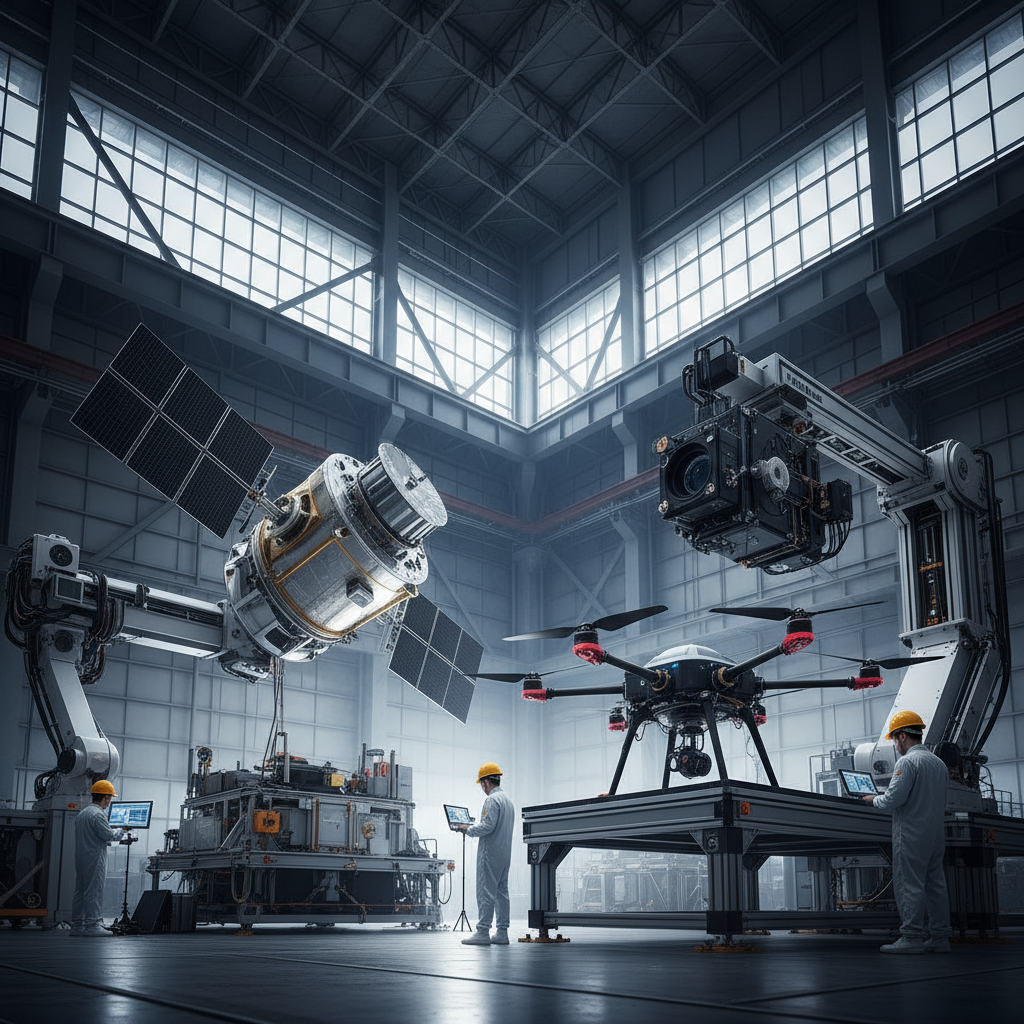
In the high-stakes realm of aerospace engineering, where a single loose screw or a microscopic hairline fracture can lead to catastrophic mission failure, vibration testing serves as the ultimate insurance policy. Whether it is a satellite enduring the violent acoustic energy of a rocket launch or a UAV navigating turbulent atmospheric currents, the ability to predict and mitigate mechanical resonance is non-negotiable for structural integrity.
Beyond mere compliance with industry standards, rigorous vibration testing allows engineers to push the boundaries of lightweight materials, such as Gallium Arsenide Solar Arrays and advanced carbon composites. By simulating the extreme G-forces and harmonic oscillations of flight, manufacturers can optimize the weight-to-strength ratio of satellite components, ensuring that every gram of payload contributes to the mission's scientific goals.
Globally, the shift toward miniaturized satellite constellations and deep-space exploration has intensified the demand for precision-engineered vibration analysis. From ensuring the stability of an optical camera to validating the deployment of a folding and unfolding mechanism, understanding the dynamics of vibration is the cornerstone of reliability in the most inhospitable environments known to mankind.
The Fundamentals of Vibration Testing in Aerospace
At its core, vibration testing is the process of subjecting a product to a set of controlled vibrations to determine its ability to withstand the environmental stresses it will encounter during its operational life. In the aerospace sector, this typically involves sine vibration, random vibration, and shock testing. Sine tests target specific resonant frequencies, while random tests simulate the chaotic energy of a launch vehicle, ensuring that components like the Power Controller or Lithium Battery Pack do not shake apart.
The goal is not merely to see if a part breaks, but to understand how and when it fails. By identifying the natural frequencies of a structure, engineers can implement damping solutions or modify the geometry of a part to shift its resonance away from the excitation frequencies of the rocket. This proactive approach prevents fatigue failure and ensures that the mission's critical hardware arrives in orbit fully functional.
Global Standards and Regulatory Compliance
The aerospace industry operates under a strict regime of international standards to ensure safety and interoperability. Organizations such as ISO, NASA, and the ESA provide comprehensive guidelines on how vibration testing should be conducted. These standards define the "Power Spectral Density" (PSD) levels that a satellite must survive, providing a mathematical blueprint for simulating the acoustic and mechanical loads of specific launch vehicles, such as the Falcon 9 or Ariane 5.
Compliance is not just a legal requirement; it is a risk management strategy. When a manufacturer certifies that their Antenna Products or TT&C Products meet MIL-STD-810G or SMC-S-016 standards, they are providing a guarantee of reliability. Failure to adhere to these global benchmarks can result in mission-ending anomalies, where a seemingly minor vibration triggers a cascading failure of the power subsystem or communication link.
Moreover, the globalization of the space supply chain means that components manufactured in one country must be compatible with launch systems in another. Standardized vibration testing protocols allow for seamless integration, ensuring that a power subsystem from one vendor integrates perfectly with the satellite chassis of another, regardless of the geographical origin of the hardware.
Core Components Subject to Mechanical Stress
Certain hardware is more susceptible to vibration than others. For instance, the Folding And Unfolding Mechanism of a solar array is a critical point of failure; any misalignment caused by launch vibrations can prevent the array from deploying, leaving the satellite without power. This makes targeted vibration testing essential for these kinematic assemblies.
Optical Cameras and high-precision sensors are equally vulnerable. Micro-vibrations, known as "jitter," can blur imagery or degrade the pointing accuracy of a satellite. By implementing advanced vibration testing using laser vibrometers, engineers can design isolation mounts that shield these sensitive instruments from the harsh mechanical environment of the spacecraft.
Finally, the structural integrity of the Space-Level Calcium-titanium-mineral Solar Cell panels must be verified. Because these cells are brittle, high-frequency vibrations can cause micro-cracking. Extensive vibration testing ensures that the bonding agents and substrates used in the panels can absorb energy without compromising the electrical efficiency of the cells.
Comparative Analysis of Testing Methodologies
Choosing the right approach to vibration testing depends on the mission profile. Sine-on-Random testing, for example, combines the targeted stress of a sine wave with the broad-spectrum energy of random vibration, providing a more realistic simulation of launch conditions. In contrast, shock testing focuses on high-amplitude, short-duration events, such as the separation of a satellite from the launch vehicle.
The efficacy of these methods is often measured by their ability to detect "weak links" in the assembly. While random testing is excellent for finding fatigue points, sine sweeps are superior for identifying the exact natural frequency of a component, allowing for precise structural tuning.
Efficiency Ratings of Vibration Testing Methodologies
Real-World Applications in Satellite Deployment
In practice, vibration testing is applied across every phase of the satellite lifecycle. During the prototyping phase, "shake and bake" tests are used to verify that the Power Sub System can withstand the thermal-vacuum environment while simultaneously enduring mechanical stress. This ensures that the heat sinks and electrical connections remain secure.
Furthermore, for UAVs operating in low-altitude, high-turbulence zones, vibration testing is used to calibrate flight control algorithms. By simulating wind-induced vibrations, engineers can program the UAV's stabilizers to compensate for mechanical oscillation, preventing "pilot-induced oscillation" and ensuring a stable platform for onboard sensors.
Long-Term Reliability and Structural Longevity
The true value of vibration testing extends far beyond the launch window. Mechanical fatigue is a cumulative process; vibrations experienced during launch can create micro-strains that only manifest as failures months or years into a mission. By conducting "accelerated life testing," engineers can simulate years of operational stress in a matter of days.
This ensures that the Satellite Components, such as the data handling units and power controllers, do not suffer from solder joint fatigue or connector loosening. The emotional peace of mind that comes from knowing a billion-dollar asset is structurally sound is an intangible but vital benefit of rigorous testing.
Ultimately, the synergy between logical engineering and empirical vibration testing builds trust with stakeholders and insurance providers. When a company can demonstrate a history of zero vibration-related failures, it establishes itself as a leader in the aerospace manufacturing sector, paving the way for more ambitious deep-space endeavors.
Future Innovations in Vibration Analysis
The future of vibration testing is being shaped by the digital twin revolution. Instead of relying solely on physical prototypes, engineers are creating high-fidelity virtual models that simulate vibration in real-time. This allows for thousands of "virtual shakes" before a single piece of metal is cut, drastically reducing the cost of development.
We are also seeing the integration of smart materials, such as piezoelectric dampers, which can actively counteract vibrations in real-time. These materials can be embedded directly into the chassis of a satellite, turning the structure itself into a vibration-absorption system.
As we move toward sustainable space exploration, the use of additive manufacturing (3D printing) allows for the creation of "lattice structures" that are naturally optimized for vibration damping. These complex geometries, which were impossible to machine traditionally, are now being validated through advanced vibration testing to ensure they meet the rigorous demands of the next generation of spacecraft.
Comparison of Vibration Testing Impact Across Satellite Subsystems
| Subsystem |
Critical Stress Point |
Test Priority |
Failure Risk |
| Solar Arrays |
Interconnect Solder |
High |
Power Loss |
| Optical Camera |
Lens Alignment |
Critical |
Image Blur |
| Power Controller |
Capacitor Mounts |
Medium |
Circuit Short |
| Battery Pack |
Cell Housing |
High |
Thermal Runaway |
| Folding Mechanism |
Hinge Pins |
Critical |
Deployment Failure |
| TT&C Antenna |
Feed Horn Bracket |
Medium |
Signal Loss |
FAQS
Sine vibration testing applies a continuous wave at a specific frequency, which is ideal for finding the resonant frequencies of a component. Random vibration testing, however, applies a broad spectrum of frequencies simultaneously, mimicking the unpredictable nature of a rocket launch. While sine testing finds the "breaking point" of a specific frequency, random testing evaluates the overall structural durability and fatigue resistance of the assembly.
Deployment mechanisms, such as folding solar arrays, rely on precise tolerances. Vibration during launch can shift these tolerances or cause "cold welding" of parts. By subjecting these mechanisms to simulated launch loads, engineers can identify if a hinge is prone to jamming or if a locking pin might shake loose, allowing them to redesign the component for absolute reliability before the actual launch.
Yes, this is known as "over-testing." If the vibration levels exceed the actual expected flight environment by a significant margin, you may induce failures that would never occur in reality. This can lead to unnecessary redesigns and increased costs. Professional aerospace engineers use "Qualification Levels" (which are higher than flight levels) and "Acceptance Levels" to ensure a safe margin of error without compromising the part's integrity through excessive stress.
The flight controller (IMU/Gyroscope) and the onboard camera are most affected. High-frequency vibrations from the motors can "noise up" the IMU data, causing the UAV to drift or crash. Using vibration isolation mounts and performing rigorous vibration testing allows manufacturers to ensure that the control system can filter out mechanical noise and maintain a stable flight path.
Virtually every component that is part of the launch mass must undergo some form of verification. While a simple bolt might not need a dedicated test, the assembly it holds does. From the Lithium Battery Pack to the smallest data cable, everything is subject to the same launch environment. Components are typically grouped into "test articles" and tested as a complete system to capture the interaction between different parts.
Digital twins allow for "virtual prototyping," where Finite Element Analysis (FEA) is used to predict how a part will react to vibration. This narrows down the design space, so that when the physical vibration testing occurs, it is used to validate a successful design rather than discover a failure. This significantly reduces the number of physical prototypes needed and accelerates the time-to-market for new satellite components.
Conclusion
In conclusion, vibration testing is far more than a checklist item; it is a critical engineering discipline that bridges the gap between a theoretical design and a successful mission. By integrating sine, random, and shock simulations, aerospace manufacturers can safeguard complex systems—from Gallium Arsenide Solar Arrays to intricate folding mechanisms—against the violent energies of launch and the subtle fatigue of orbit. The combination of global standards, rigorous empirical data, and emerging digital twin technologies ensures that humanity's reach into the cosmos remains secure.
Looking forward, the evolution of smart materials and additive manufacturing will continue to redefine how we approach mechanical resonance. As we aim for more ambitious targets like Mars and beyond, the precision of our vibration analysis will be the deciding factor in the longevity of our interstellar infrastructure. We encourage engineers and procurement specialists to prioritize high-fidelity testing to ensure their hardware is not just "flight-ready," but "mission-guaranteed." Visit our website for more expert insights: www.space-navi.com