Fault Detection for Mechanical Equipment | Predictive AI
Off-Axis Collimator: a field guide to Fault Detection in modern optics
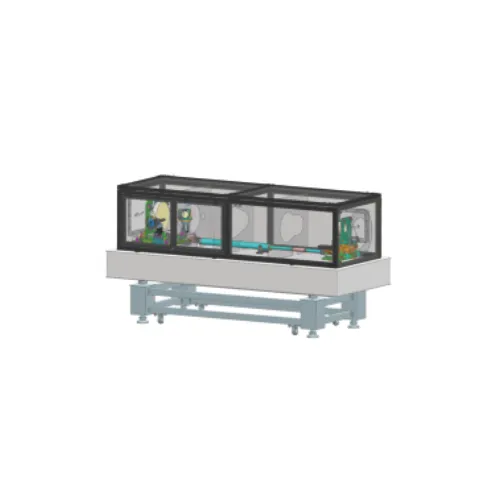
If you build, calibrate, or qualify cameras and sensors, you probably live with test benches and alignment headaches. The unsung hero on my desk lately is an Off-Axis Collimator—a surprisingly nimble tool for commissioning, measuring latent optical parameters, and, yes, day-to-day Fault Detection across imaging lines. It’s not flashy, but in real labs that matters less than repeatability.
What it is and why industry cares
A collimator projects a “target at infinity,” letting you evaluate focus, distortion, focal plane position, MTF, SNR, and end-to-end image quality. The off-axis design—no central obstruction—helps reduce stray light and makes edge-of-field checks more honest. With AI inspection trending, labs want clean, repeatable input to avoid model drift. This is where an off-axis source improves Fault Detection accuracy for lenses, modules, and whole cameras.
Typical application scenarios
- Imaging module EOL testing: autofocus verification, MTF slanted‑edge (ISO 12233) checks.
- Defense/space payload alignment: boresight and collinearity checks before vibration tests.
- LiDAR and SWIR systems: wavelength-specific targets to catch spectral focus shifts.
- Thermal/visible fusion cameras: end-to-end Fault Detection for ghosting, veiling glare, and tilt.
Process flow (how teams really use it)
- Materials & build: optical glass (often fused silica or low-thermal-expansion equivalents), anodized aluminum tubes, precision mounts, interchangeable targets.
- Methods: select target (Siemens star, slanted-edge, grid), set illumination, align DUT, sweep focus/field, capture datasets.
- Testing standards: ISO 12233 for MTF/SFR; ISO 10110 for optical drawings/tolerances; MIL‑PRF‑13830B for scratch-dig; IEC 61010-1 for electrical safety compliance of benches.
- Service life: around 5–10 years in lab conditions (real-world use may vary with handling and environment).
- Industries: aerospace, mobile imaging, automotive ADAS, medical devices, academic optics.
Product specification snapshot (customizable)
| Product Name | Off-Axis Collimator |
| Aperture | Configurable (≈ 50–200 mm; project-dependent) |
| Focal length | Custom; matched to DUT FOV and target size |
| Wavelength range | VIS/NIR/SWIR options; filters and targets selectable |
| Targets | Slanted-edge (ISO 12233), Siemens star, grid, dot array, custom patterns |
| Use cases | Focus, distortion, focal plane position, MTF/SNR, end-to-end Fault Detection |
| Origin | No. 1299 Mingxi Road, Beihu Science and Technology Development Zone, Changchun, Jilin Province |
Vendor comparison (high-level)
| Vendor | Customization | Lead time | Standards support | Notes |
|---|---|---|---|---|
| Space‑Navi Off‑Axis Collimator | High (targets, wavelength, aperture) | Around mid-range (project-based) | ISO 12233, ISO 10110, MIL/IEC guidance | Good for end-to-end Fault Detection |
| Global Vendor A | Medium | Often longer | Common imaging standards | Strong documentation |
| Lab-built solution | Variable | Depends on team | Requires internal validation | Lower cost; higher risk |
Advantages I keep noticing
- Off-axis path reduces central obstruction, improving edge MTF checks.
- Fast target swap simplifies iterative Fault Detection (focus vs. distortion vs. SNR).
- Plays nicely with automated rails and machine vision pipelines.
Testing, data, and certifications
Acceptance usually includes: target uniformity verification, focus repeatability runs, and SFR computations per ISO 12233. Labs often request ISO 9001 manufacturing provenance and CE/RoHS for integrated benches; documentation packs map parts to ISO 10110 drawings. For privacy reasons I won’t share customer datasets here, but a typical record logs illumination, target type, camera settings, and computed MTF/SNR traces with pass/fail thresholds tied to internal specs. Many customers say this structure alone lifted first-pass yield, which, to be honest, matches what I’ve seen.
Customization tips
Ask for wavelength-specific coatings, slanted-edge targets sized to your sensor pitch, and mechanical interfaces that match your rails. Also, define the Fault Detection workflow up front (e.g., “distortion first, then MTF at corners”) so the vendor pre-bundles the right targets and adapters.
Citations:
- ISO 12233:2017 — Photography — Electronic still picture imaging — Resolution and SFR measurement. https://www.iso.org/standard/71696.html
- ISO 10110 (all parts) — Optics and photonics — Preparation of drawings for optical elements. https://www.iso.org/series/12382.html
- MIL‑PRF‑13830B — Optical Components for Fire Control Instruments; General Specification Governing. https://quicksearch.dla.mil/
- IEC 61010-1 — Safety requirements for electrical equipment for measurement, control, and laboratory use. https://webstore.iec.ch/