
Which component for thermal control system, TVAC-tested?
Why the Multi-Layer Thermal Insulation Cover is quietly redefining spacecraft thermal control
Thermal budgets got tighter as smallsats went mainstream, and deep-space missions pushed temperature extremes. In that shuffle, the humble thermal blanket moved from “afterthought” to mission-critical. I’ve toured enough cleanrooms to know: when your radiator sizing is on the edge, a well-built Multi-Layer Thermal Insulation Cover can be the difference between nominal ops and a long night of telemetry triage.
Industry trends (and a few hard truths)
The market has shifted toward lighter, cleaner, and more modular MLI. Operators want lower integration time, lower outgassing, and consistent performance from LEO to cislunar or cryo ground transport. Frankly, cost pressure is real, but so are performance demands: equivalent thermal conductivity down to ≈1×10^-5 W/(m·K) in high vacuum is now the bar, not the moonshot.
What it is (and what’s inside)
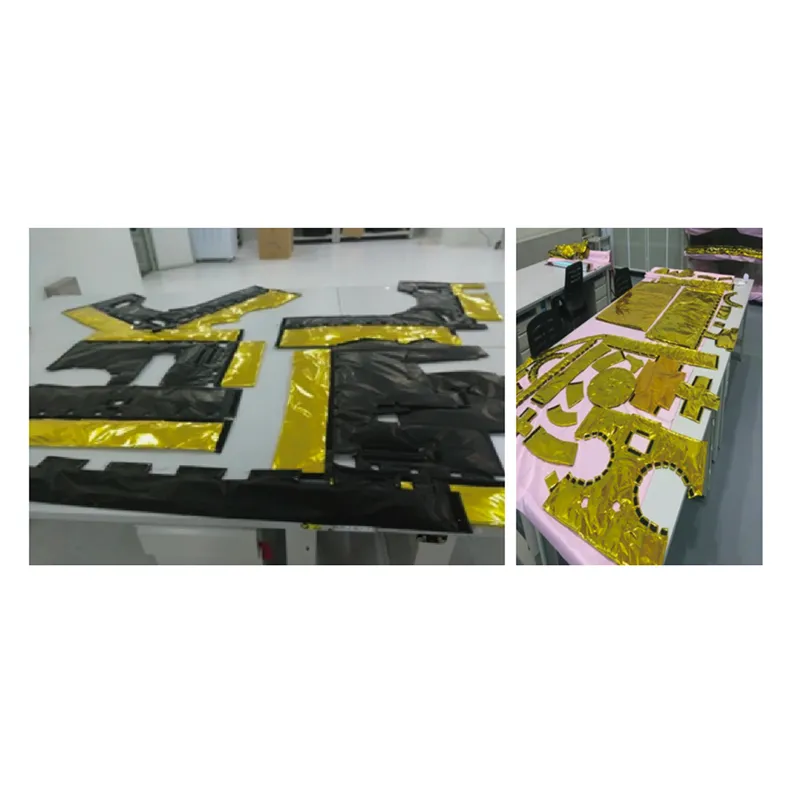
A typical Multi-Layer Thermal Insulation Cover stacks aluminized polyimide or PET reflectors with low-conductance spacers (think polyester net or silk-like glass fiber) in a carefully vented, clean, stitched or spot-welded assembly. The result: very low radiative heat transfer, minimal conduction, and almost no particulates if you build it right.
Product specifications (typical)
| Parameter | Typical Value | Method / Notes |
|---|---|---|
| Equivalent thermal conductivity | ≈1×10^-5 W/(m·K) | High vacuum; real-world use may vary with layer count and compression |
| Mass per area | ~0.2–0.35 kg/m² | Depends on film gauge and spacer density |
| Operating temperature | -200°C to +200°C | Material set: aluminized polyimide / PET |
| Outgassing (TML/CVCM) | TML ≤1.0%, CVCM ≤0.1% | ASTM E595 screening |
| Cleanliness | ISO 8–7 (assembly target) | ISO 14644 |
Process flow (how it’s built and proven)
- Materials: aluminized polyimide/PET reflectors; polyester/glass spacers; low-outgassing sewing thread.
- Methods: patterning and kitting, layer stacking, ultrasonic tacking or sewing, edge taping, venting features, labeling.
- Testing: outgassing per ASTM E595; TVAC cycling (GEVS/ECSS); emissivity/emittance checks; fit checks on flight-like structure.
- Service life: around 10–15 years in LEO; longer for ground cryo uses (storage dependent).
- Industries: spacecraft, launch vehicles, cryogenic transport, quantum/HTS labs, medical MRI shielding.
Applications and advantages
The Multi-Layer Thermal Insulation Cover is light, non-dusting, and installs quickly—many customers say the easy fit-up surprised them. On orbit, it damps thermal swings on avionics decks, batteries, and prop tanks; on the ground, it reduces boil-off for LN2/LHe dewars. And yes, it’s friendly to rapid integration schedules.
Vendor snapshot (quick comparison)
| Vendor | Lead Time | Certifications | Notes |
|---|---|---|---|
| Space-Navi (Changchun, Jilin) | ≈3–6 weeks | ISO 9001; AS9100 (on request) | Custom patterns; flight heritage claimed; origin: No. 1299 Mingxi Road, Beihu Zone |
| DUNMORE | 4–8 weeks | ISO 9001 | Strong film portfolio; broad material options |
| Sheldahl | 4–10 weeks | AS9100 | High-reliability builds; heritage in space laminates |
Data is indicative; real-world lead times and certifications may vary by site and program.
Customization
Layer count (10–30+), film type (polyimide/PET), spacer density, stitch vs. ultrasonic, color coding, laser-cut apertures, vent paths, Kapton labels—if you can CAD it, odds are it can be kitted. The Multi-Layer Thermal Insulation Cover ships flat or pre-formed for complex curvature.
Case notes from the field
- Smallsat battery bay: ±3°C orbital swing instead of ±10°C after retrofit; operators reported fewer heater cycles.
- Cryogenic tank logistics: ~22% reduction in boil-off on a 48-hour road leg, verified with inline mass flow meters.
Compliance and test data
Built for ASTM E595 outgassing limits, TVAC cycling per GEVS, and emissivity verification. Programs typically request traceable lot records, FAI, and cleanliness checks (ISO 14644). If you’re flying beyond LEO, ask for extended bakeouts and enhanced venting features—worth it, to be honest.
Authoritative citations
- ASTM E595 – Standard Test Method for Total Mass Loss and Collected Volatile Condensable Materials. https://www.astm.org/e0595
- NASA GEVS (GSFC-STD-7000) – General Environmental Verification Standard. https://standards.nasa.gov
- ISO 14644 – Cleanrooms and associated controlled environments. https://www.iso.org/standard/37381.html
- ECSS-Q-ST-70-02 – Thermal vacuum outgassing test for the screening of space materials. https://ecss.nl











