Understanding Data Communication Satellites and Their Vital Role in Global Connectivity
Understanding Data Communication Satellites
In today’s interconnected world, reliable communication is paramount. Data communication satellites play a critical role in enabling this connectivity, bridging vast distances and facilitating global data transfer. These sophisticated systems are essential for everything from internet access in remote areas to crucial data relay for emergency services. This article will explore the technology behind these satellites, their diverse applications, the challenges involved, and future trends, offering insight into the vital role they play in modern society.

How Data Communication Satellites Work
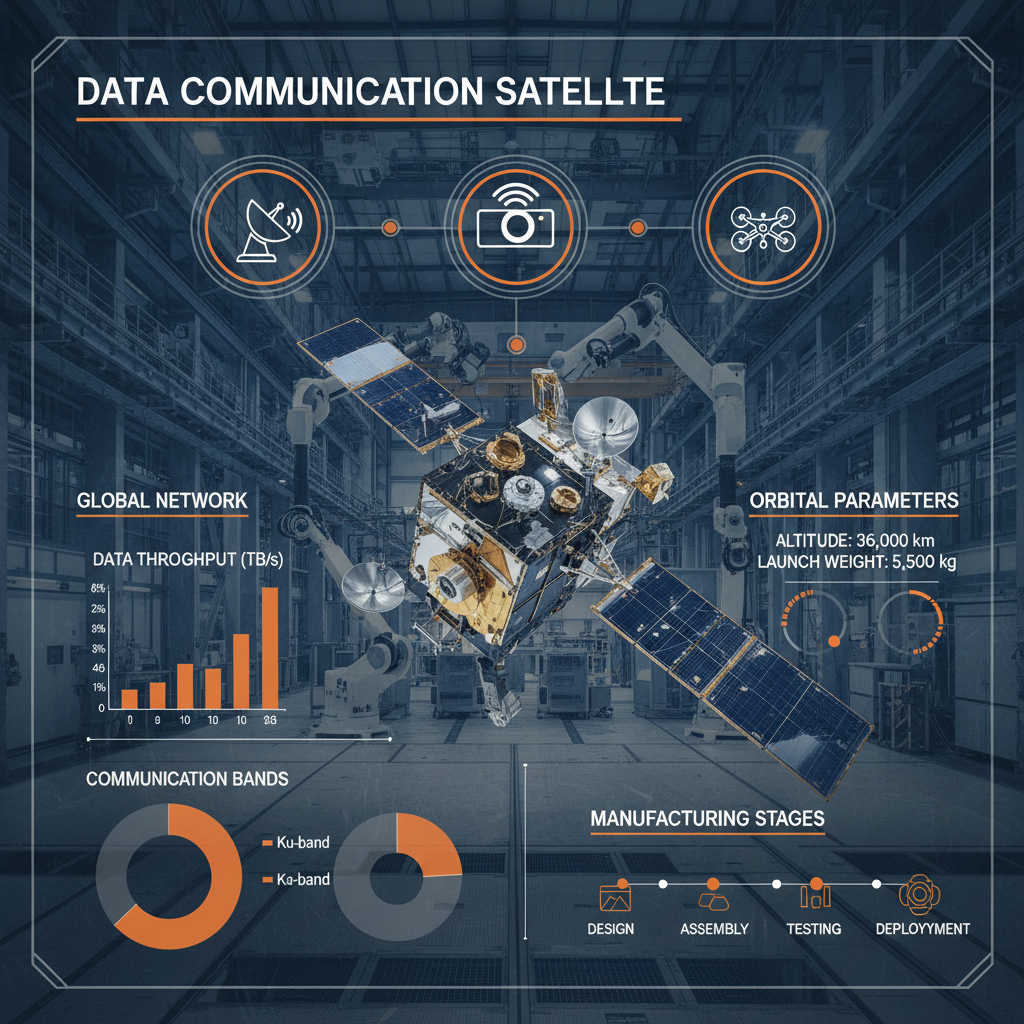
At their core, data communication satellites function as relay stations in space. A ground station transmits an uplink signal to the satellite, which then amplifies and retransmits the signal to another ground station – the downlink. These satellites utilize various frequency bands (C-band, Ku-band, Ka-band) to optimize signal transmission and minimize interference. The process involves modulation of data onto carrier waves, transmission through space, and demodulation at the receiving end. Different orbital types – Geostationary Orbit (GEO), Medium Earth Orbit (MEO), and Low Earth Orbit (LEO) – offer different advantages in terms of coverage, latency, and cost. Space-Navi provides detailed information on satellite technologies and services.
Key Takeaway: Data communication satellites act as intermediaries, relaying signals between ground stations and enabling global data transmission.
Applications of Data Communication Satellites
The applications of these satellites are incredibly diverse. They underpin global internet connectivity, particularly in areas where terrestrial infrastructure is limited. They’re vital for broadcasting television and radio signals, facilitating remote education and telehealth services. Critical infrastructure, such as banking and financial networks, rely on satellite communications for secure data transfer. Emergency services utilize satellite links for disaster response and communication in areas affected by natural disasters. Furthermore, they are instrumental in meteorological data collection and tracking, providing essential information for weather forecasting.
Key Applications:
• Global Internet Access
• Broadcasting (TV & Radio)
• Secure Data Transfer for Finance
• Emergency Communications
• Weather Forecasting
Data Communication Satellite Orbital Types: A Comparison
Selecting the appropriate orbital type is crucial for optimizing satellite performance. GEO satellites, positioned approximately 35,786 km above the Earth, provide wide coverage but experience higher latency. MEO satellites, orbiting at around 2,000-35,786 km, offer lower latency and better signal strength. LEO satellites, situated at altitudes of 160-2,000 km, provide the lowest latency and are ideal for real-time applications but require a larger constellation for continuous coverage. The best choice depends on the specific application requirements and budgetary constraints. You can learn more about different satellite orbits at Space-Navi's resource page.
Challenges and Future Trends in Data Communication Satellites
Despite their advancements, data communication satellites face ongoing challenges. Space debris poses a significant threat to satellite functionality and longevity. Increasing demand for bandwidth necessitates the development of higher-capacity satellites and more efficient spectrum utilization. Cybersecurity threats also loom large, requiring robust encryption and security protocols. Looking ahead, we can expect to see the proliferation of LEO satellite constellations, such as Starlink, offering high-speed, low-latency internet access globally. Advancements in satellite technology, including optical communication and onboard processing, will further enhance performance and reduce costs. Space-Navi tracks these developments closely.
Conclusion: The Future is Connected
Data communication satellites are indispensable for modern communication, bridging geographical barriers and connecting people worldwide. As technology continues to evolve, we can anticipate even more innovative applications and improved performance. Addressing the challenges of space debris, cybersecurity, and bandwidth demands will be crucial for ensuring the long-term sustainability and effectiveness of these vital systems. The team at Space-Navi remains committed to providing insights and updates on this dynamic field.
Frequently Asked Questions (FAQs)
What is the difference between C-band, Ku-band, and Ka-band?
These terms refer to different frequency bands used for satellite communication. C-band operates at lower frequencies and is less susceptible to rain fade, making it reliable in adverse weather conditions. Ku-band offers higher bandwidth but is more prone to rain fade. Ka-band provides the highest bandwidth but is the most susceptible to rain fade and requires more sophisticated technology. The choice of band depends on the specific application and environmental conditions. Different bands are better suited for different purposes, based on cost, bandwidth needs, and geographic location.
How does space debris impact data communication satellites?
Space debris, including defunct satellites, rocket fragments, and other objects, poses a significant threat to operational satellites. Even small pieces of debris traveling at high speeds can cause serious damage upon impact. This can lead to malfunctions, reduced performance, or complete satellite failure. Satellite operators employ tracking and avoidance maneuvers to mitigate this risk, but the increasing amount of space debris is becoming a growing concern, necessitating international cooperation and debris removal technologies.
What is the role of optical communication in future satellite technology?
Optical communication, using lasers to transmit data, offers significantly higher bandwidth and improved security compared to traditional radio frequency (RF) communication. It also requires less power and offers more precise targeting. While still in its early stages of development, optical communication is poised to revolutionize satellite data transfer, enabling faster and more reliable connections. This technology is becoming increasingly important as data demands continue to rise.
Are data communication satellites vulnerable to cyberattacks?
Yes, data communication satellites are increasingly vulnerable to cyberattacks. Hackers could potentially disrupt satellite operations, intercept data transmissions, or even take control of the satellite. Protecting these critical infrastructure assets requires robust cybersecurity measures, including encryption, authentication, and intrusion detection systems. Ongoing vigilance and proactive security protocols are essential to mitigate these threats and ensure the integrity of satellite communication networks.