Functional and performance testing aims to verify that all operations required for the satellite to execute actual missions function properly. It also synchronously validates the satellite’s hardware and software, and confirms the communication reliability between the satellite and ground stations through end-to-end testing.
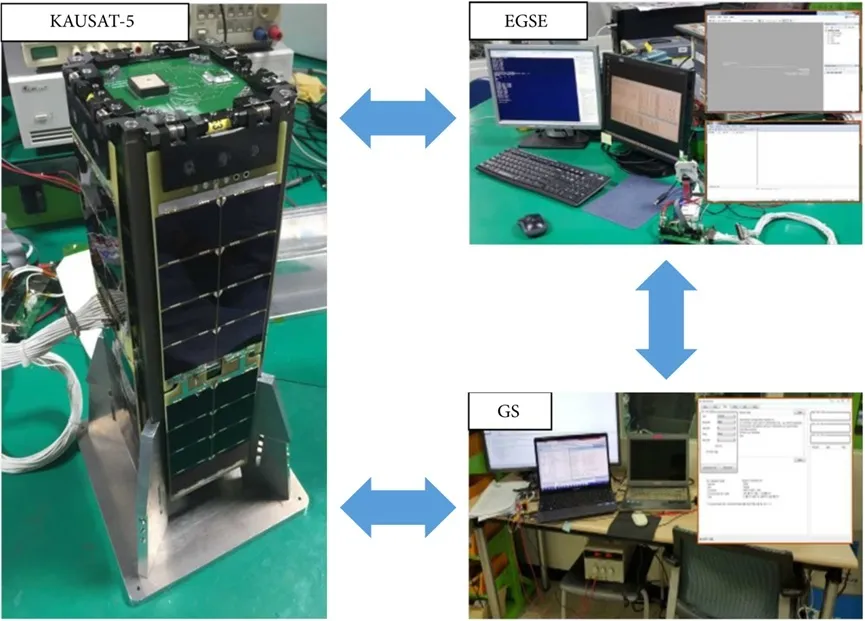
KAUSAT-5 Functional Test Layout
The figure outlines the overview process of functional testing:
- First, connect the CubeSat, EGSE (Electrical Ground Support Equipment), and ground station, and check whether satellite operations comply with procedural requirements;
- Second, verify remote operation functions by transmitting actual radio commands to the platform system and integrating ground station communication equipment;
- Finally, compare data from the EGSE with data received by the ground station to validate data consistency.
-
For conventional satellites, qualification testing must be conducted at the component, material, subassembly, and mechanical system levels. When necessary, partial qualification can be performed at the system level using a Protoqualification Model (PQM) or Protoflight Model (PFM). However, small satellites such as 3U CubeSats are composed of a small number of micro-components and PCB-level modules, and a single CubeSat can be regarded as an integrated component. Thus, complete system-level qualification testing can be carried out.
Before launch, satellites or components must pass qualification-level environmental testing to verify design margins and ensure stability in space. Qualification-level environmental test conditions are stringent and highly selective for satellites, so Qualification Models (QM) cannot be used as flight models. Actual Flight Models (FM) need to undergo testing at lower test levels or for shorter durations to confirm the reliability of satellite production processes.
To verify space environmental adaptability, the research team developed the KAUSAT-5 Engineering Qualification Model (EQM) and validated the satellite’s design margins through qualification-level environmental testing; for the Flight Model, acceptance-level environmental testing was conducted. For future satellite development based on this qualified standard platform, payloads can be adapted according to required performance without repeating qualification testing—only acceptance testing is needed. This is expected to reduce costs and shorten the development cycle.