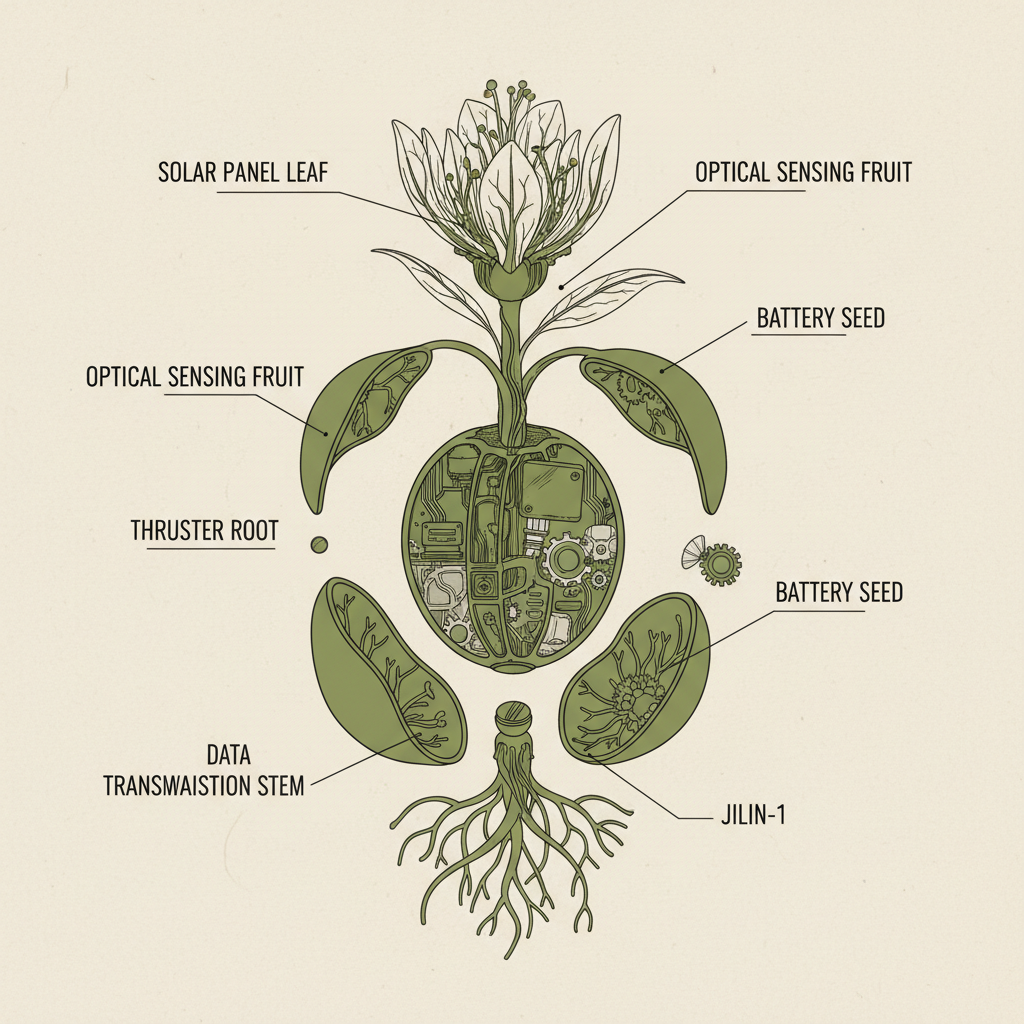
The global connectivity landscape is shifting from terrestrial-centric models to hybrid architectures where orbital assets play a decisive role. This transition is driven by the rise of space internet companies that are deploying massive constellations to eliminate the "digital divide" in remote regions and provide low-latency backhaul for critical infrastructure.
Unlike traditional geostationary satellites, modern space-based internet relies on Low Earth Orbit (LEO) networks. This shift necessitates a complete overhaul of the satellite hardware ecosystem, moving away from monolithic, expensive platforms toward mass-produced, high-performance components that can be deployed by the thousands.
Understanding the technical dependencies of these networks—from power generation to precise optical alignment—is essential for stakeholders evaluating the sustainability and scalability of the current space economy.


The emergence of commercial space internet companies has redefined the orbit economy. We have moved from a "bespoke" era, where a single satellite cost hundreds of millions, to an era of "constellation" thinking. This requires a fundamental change in manufacturing, where the focus is on satellite platform and load integration to reduce weight and cost.
For instance, optimizing the satellite bus from a 400kg initial generation down to a 20kg form factor enables more efficient launch cycles and higher redundancy. This miniaturization is critical for maintaining a dense mesh of nodes required for high-speed internet coverage.
To sustain a global network, satellites require a highly reliable Power Sub System. The synergy between Gallium Arsenide solar arrays and advanced Lithium Battery Packs ensures that the satellite remains operational during eclipse periods while providing steady voltage to the onboard electronics and TT&C (Telemetry, Tracking, and Command) products.
Beyond power, the communication payload relies on sophisticated Antenna Products and folding/unfolding mechanisms. These mechanical systems must operate with absolute reliability in the vacuum of space, as any failure in the deployment of an antenna or solar array renders the entire orbital node useless.
Furthermore, the integration of UAVs and satellite data services is creating a multi-layered communication web. This air-space-ground integrated remote sensing approach allows for real-time data relay, where UAVs act as local collectors and satellites act as the high-capacity transit layer.
As space internet companies push for higher bandwidth, optical communication (laser links) is replacing traditional RF for inter-satellite links. This transition places an immense burden on optical instrument precision, specifically the ability to maintain a narrow, parallel beam over thousands of kilometers.
Precision collimators are the "hidden heroes" of optical payloads; by eliminating angular divergence, they ensure that light beams remain parallel, which is the critical requirement for high-accuracy laser targeting and long-distance data transmission.
Implementing these systems requires specialized optical processing. Utilizing glass ceramics or silicon carbide for components helps mitigate thermal expansion issues, ensuring that focal lengths (such as 5m or 16m in specialized collimators) remain stable despite the extreme temperature fluctuations of the orbital environment.
Evaluating the viability of a satellite constellation requires a balanced look at technical trade-offs. Weight reduction must not compromise structural integrity, and power efficiency must be weighed against the total mass of the solar arrays.
The following conceptual index illustrates the relative importance of different hardware subsystems in achieving a low-latency, high-reliability network. This model reflects a typical priority matrix for commercial LEO operators.
Deployment is not merely about launch, but about the precision of the initial orbital insertion and the subsequent unfolding of critical components. A common failure point is the mechanical interface of the solar arrays; if the folding and unfolding mechanism jams, the satellite cannot recharge its batteries, leading to a total loss of the asset.
Furthermore, the "supply cycle" for specialized components—such as the 4 to 8-month lead times for precision collimators—can create bottlenecks for companies attempting to scale their constellations rapidly. This makes the reliability of the supply chain as critical as the reliability of the hardware itself.
The power requirements of space internet nodes are increasing as onboard processing for data routing becomes more complex. Traditional silicon cells are being replaced by high-efficiency Gallium Arsenide and Perovskite solutions to maximize the power-to-weight ratio.
Integrating these with a robust Power Controller is essential to prevent surges during the rapid transition between sunlight and shadow. The use of space-level calcium-titanium-mineral solar cells represents a niche but promising direction for increasing durability in high-radiation environments.
The ultimate goal is to create a "plug-and-play" power subsystem that can be integrated into various satellite buses regardless of the specific mission payload, reducing the engineering overhead for each new launch batch.
Selecting the right hardware for an orbital internet node requires a rigorous trade-off analysis. For example, choosing between a focal length of 5m versus 16m for a collimator depends entirely on the required field of view and the target beam divergence.
Decision-makers must evaluate components based on their "space-readiness"—the ability to withstand vacuum, radiation, and thermal cycling—rather than just their laboratory performance. This involves checking the aperture and field-of-view specs against the specific orbital altitude and coverage requirements.
The following table provides a relative suitability framework for different component types based on common mission priorities for commercial constellations.
| Component Type | Primary Metric | Critical Risk | Relative Suitability |
|---|---|---|---|
| GaAs Solar Arrays | Efficiency % | Degradation | High (Standard) |
| Precision Collimators | Angular Divergence | Alignment Shift | High (Laser-Link) |
| Lithium Battery Packs | Energy Density | Thermal Runaway | High (Essential) |
| Folding Mechanisms | Deployment Reliability | Mechanical Jam | Medium (Critical) |
| Power Controllers | Voltage Stability | Radiation SEU | High (Systemic) |
| Optical Cameras | Resolution/FOV | Lens Distortion | Medium (Payload) |
Latency is primarily reduced by deploying satellites in Low Earth Orbit (LEO), typically between 500km and 2,000km. Because the signal travels a much shorter distance than it would to a geostationary satellite (at 35,786km), the round-trip time is significantly decreased. Additionally, the use of inter-satellite laser links allows data to travel in the vacuum of space, where light moves faster than it does through fiber-optic cables on Earth.
A collimator is an optical device that takes divergent light and makes it parallel. In the context of space-based internet, precision collimators are essential for laser communication terminals. They ensure that the laser beam remains tightly focused over vast distances, minimizing signal loss and ensuring the beam accurately hits the receiving aperture of another satellite or a ground station.
Gallium Arsenide (GaAs) cells offer significantly higher conversion efficiency and better radiation resistance than traditional silicon cells. In the harsh environment of space, where weight is a primary constraint, GaAs allows satellites to generate more power from a smaller, lighter surface area, which is critical for the miniaturized platforms used by modern constellation operators.
The primary risk is mechanical failure during the unfolding of antennas or solar arrays. Due to the vacuum and extreme temperature swings of space, materials can contract or seize. If a folding mechanism fails, the satellite may be unable to communicate or power itself, leading to "infant mortality" of the asset. Rigorous testing and the use of specialized space-grade lubricants and materials are required to mitigate this.
The rapid scale-up required for global coverage often clashes with the long lead times of high-precision components. For example, specialized optical components like collimators can have supply cycles of 4 to 8 months. This creates a dependency where the launch schedule is dictated by the manufacturing capacity of a few specialized vendors rather than the availability of launch vehicles.
Yes, through an integrated air-space-ground architecture. UAVs can serve as the "last mile" of connectivity or as mobile sensing nodes that relay data to a LEO satellite. This hybrid approach allows for high-resolution remote sensing and real-time communication in areas where ground-based infrastructure is entirely absent, creating a seamless data pipeline from the atmosphere to orbit.
The success of the next generation of orbital networks depends less on the ambition of the business model and more on the reliability of the underlying hardware. The shift toward miniaturized, integrated platforms—reducing weight from 400kg to 20kg—demonstrates that the industry is maturing toward a sustainable, mass-production model.
As laser communication becomes the standard, the demand for extreme optical precision will only grow. Companies that can bridge the gap between high-volume manufacturing and space-grade reliability will be the ones providing the essential building blocks for the future of global connectivity.