- Afrikaans
- Albanian
- Amharic
- Arabic
- Armenian
- Azerbaijani
- Basque
- Belarusian
- Bengali
- Bosnian
- Bulgarian
- Catalan
- Cebuano
- China
- Corsican
- Croatian
- Czech
- Danish
- Dutch
- English
- Esperanto
- Estonian
- Finnish
- French
- Frisian
- Galician
- Georgian
- German
- Greek
- Gujarati
- Haitian Creole
- hausa
- hawaiian
- Hebrew
- Hindi
- Miao
- Hungarian
- Icelandic
- igbo
- Indonesian
- irish
- Italian
- Japanese
- Javanese
- Kannada
- kazakh
- Khmer
- Rwandese
- Korean
- Kurdish
- Kyrgyz
- Lao
- Latin
- Latvian
- Lithuanian
- Luxembourgish
- Macedonian
- Malgashi
- Malay
- Malayalam
- Maltese
- Maori
- Marathi
- Mongolian
- Myanmar
- Nepali
- Norwegian
- Norwegian
- Occitan
- Pashto
- Persian
- Polish
- Portuguese
- Punjabi
- Romanian
- Russian
- Samoan
- Scottish Gaelic
- Serbian
- Sesotho
- Shona
- Sindhi
- Sinhala
- Slovak
- Slovenian
- Somali
- Spanish
- Sundanese
- Swahili
- Swedish
- Tagalog
- Tajik
- Tamil
- Tatar
- Telugu
- Thai
- Turkish
- Turkmen
- Ukrainian
- Urdu
- Uighur
- Uzbek
- Vietnamese
- Welsh
- Bantu
- Yiddish
- Yoruba
- Zulu
Remote Sensing Data—Satellite Processed, Time Series Ready?
Why remote sensing just became the quiet workhorse of energy finance
If you’ve worked around grid operations or project finance in the last five years, you’ve probably noticed the same thing I have: remote sensing data went from “nice-to-have imagery” to the compliance engine sitting behind real money decisions. To be honest, I didn’t expect the switch to flip this fast. But here we are—constellations are denser, SAR is cheaper, and policy deadlines don’t wait.
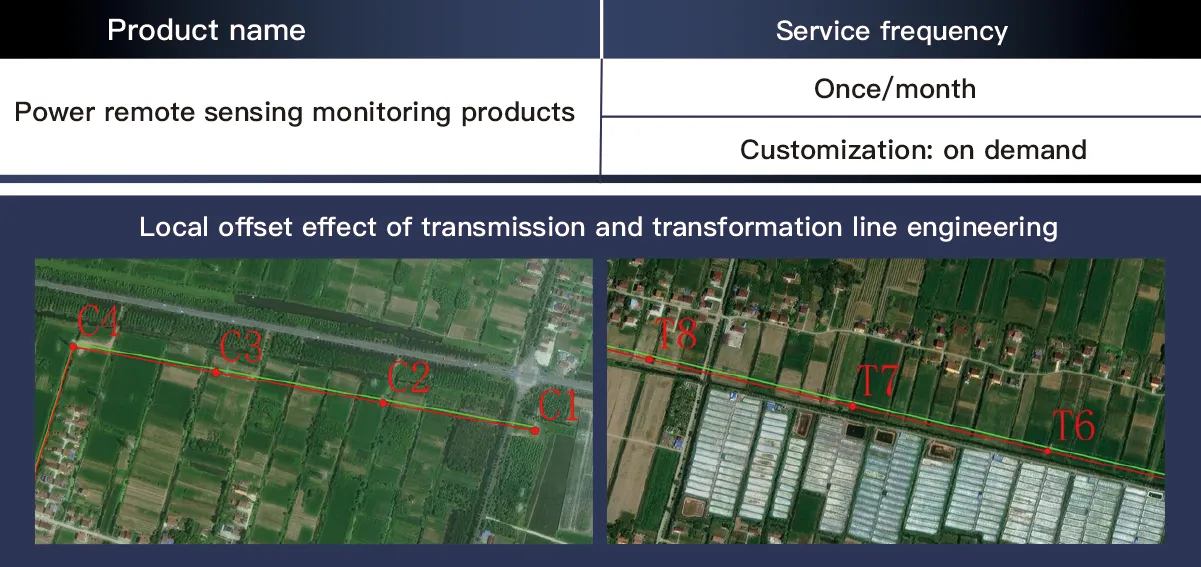
Product snapshot: Energy Finance Field Application
Built for grid owners and regulators with exact buffer requirements—strict inspection within 300 m, prevention and control in 500 m, and general survey out to 1 km—Energy Finance Field Application (origin: No. 1299 Mingxi Road, Beihu Science and Technology Development Zone, Changchun, Jilin Province) packages remote sensing data into audit-ready layers. It sounds procedural—and it is—but it also saves time, and frankly, arguments.
Industry trends (the short version)
- Daily or sub-weekly revisits from LEO constellations; SAR fills cloudy gaps.
- COGs, WMS/WCS streams, and lightweight vector change logs mean less file shuffling.
- Model governance is creeping in: traceable QA, ISO/OGC tags, and versioned detections.
Process flow, materials, and methods
- Materials: multispectral (≈0.5–3 m GSD), SAR (C/X-band), LiDAR where available, plus cadastral and grid centerline vectors.
- Methods: orthorectification (DEM-backed), atmospheric correction, object-based image analysis, change detection, and risk scoring tuned to 300 m / 500 m / 1 km buffers.
- Testing standards: ISO 19115/19157 metadata and data quality, OGC WMS/WCS/WMTS endpoints, CEOS QA4EO guidance; positional checks vs ground control and IEC corridor specs.
- Service life: data retention ≈7–10 years (policy-defined); model refresh every ≈90 days or on constellation updates; SLA-backed API uptime ≈99.5% (real-world use may vary).
- Industries: power transmission and distribution, energy lending, insurance, forestry easements, municipal planning.
Product specifications
| Spec | Aplikasyon sa Larangan ng Pananalapi ng Enerhiya |
|---|---|
| Spatial Resolution | ≈0.5–3 m (optical), ≈1–10 m (SAR), fused for corridor detail |
| Revisit / Latency | Daily to weekly; delivery T+24–72 h typical |
| Buffer Compliance | Strict 300 m; Prevention 500 m; General 1 km (configurable) |
| Accuracy (CE90) | ≈5–10 m corridor-wide; local GCPs improve to ≈3–5 m |
| Formats & APIs | GeoTIFF/COG, GeoJSON/Parquet; OGC WMS/WCS, REST/Tile |
| QC & Certification | ISO 19157 quality reports; audit logs exportable |
Vendor comparison (indicative)
| Feature | Space‑Navi App | Vendor P (constellation-class) | Vendor M (very-high-res) |
|---|---|---|---|
| Corridor Buffers | 300/500/1000 m presets | Custom scripting | Manual setup |
| Latency | T+24–72 h | T+24–96 h | T+48–120 h |
| Audit Trails | Native, exportable | Add-on | Limited |
| Cost per km² | Mid (bundled) | Low–mid (volume) | High (premium) |
Note: values are indicative; real-world use may vary.
Customization and deployment
- Model tuning for vegetation encroachment vs construction intrusion using remote sensing data plus local labels.
- On‑prem or VPC deployment; APIs for EAM/SCADA, lender dashboards, GIS.
- Data residency options and redaction pipelines for sensitive corridors.
What users say
“We cut site patrols by around 28% and stopped debating what’s inside the 500 m ring,” one utility planner told me. Another bank analyst said the remote sensing data overlays “finally made covenants measurable.” Test runs show F1 ≈0.90–0.93 for encroachment detection on mixed terrain (n≈8,000 tiles), validated to ISO 19157 checks.
Quick case notes
- Provincial grid: quarterly remote sensing data scans flagged 37 high-risk objects inside 300 m; remediation averaged 11 days sooner than prior year.
- Project finance: lender-side watchlist used 1 km general surveys to verify land-use compliance, preventing a penalty clause trigger on a 220 kV line.
Citations
- ISO 19115: Geographic information — Metadata.
- ISO 19157: Geographic information — Data quality.
- OGC Web Map Service (WMS) and Web Coverage Service (WCS) Standards.
- CEOS QA4EO: Quality Assurance Framework for Earth Observation.
- IEC 60826: Design criteria of overhead transmission lines (corridor considerations).