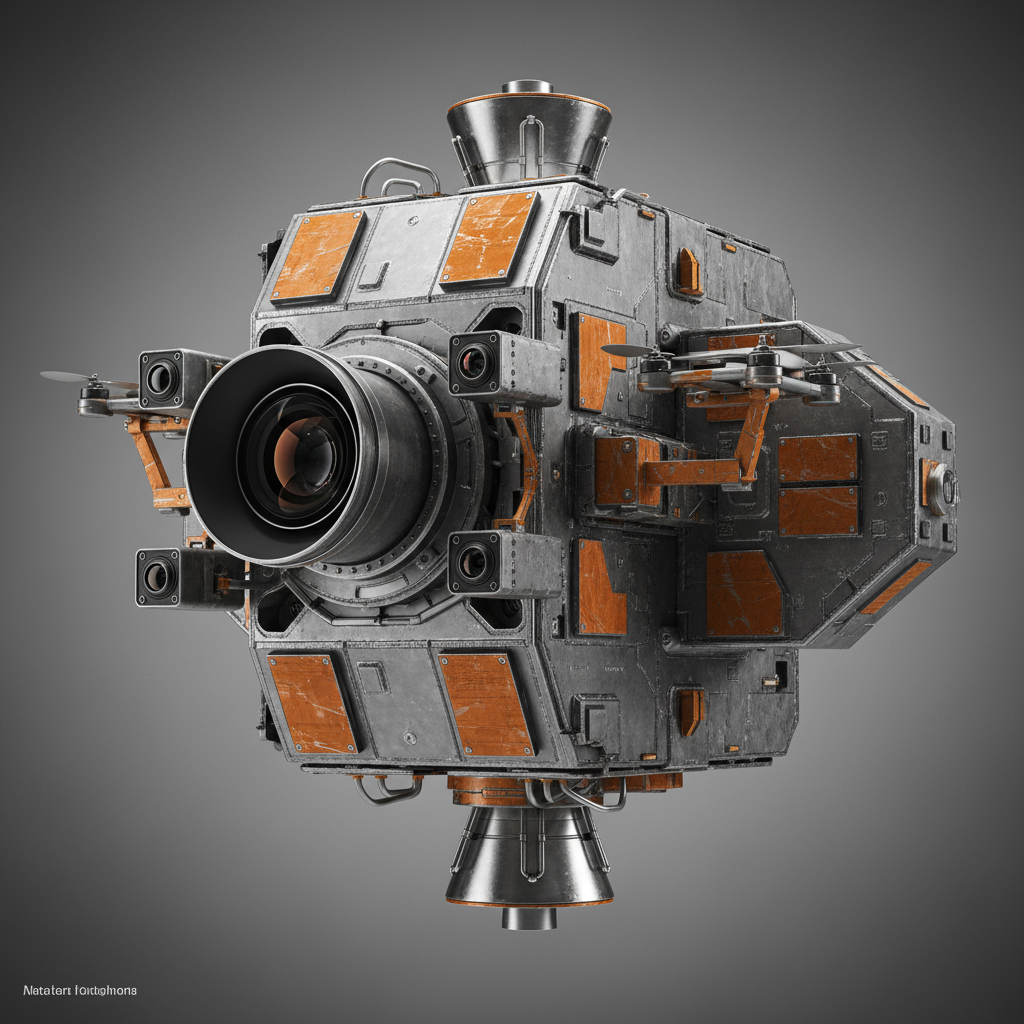
The purpose of shock testing is to verify the satellite’s resistance to shock environments induced by rocket stage separation and solar panel deployment, as well as its capability to withstand non-repetitive environments during normal operation. The shock testing of KAUSAT-5 adopts the thermal shock test method, and the test procedure is consistent with that of vibration testing: the test model is integrated into the P-POD (CubeSat Deployer), with testing conducted separately along the x-axis, y-axis, and z-axis. After the test, a visual inspection is performed to check for damaged components inside the satellite, and functional testing is carried out to confirm the satellite’s operational status.
Shock testing of KAUSAT-5 is only conducted at the qualification level for the QM (Qualification Model), and the deformation level of the shock test is analyzed under the same conditions. The shock conditions are specified as follows: 30g (20Hz) and 1000g (1000~10000Hz).
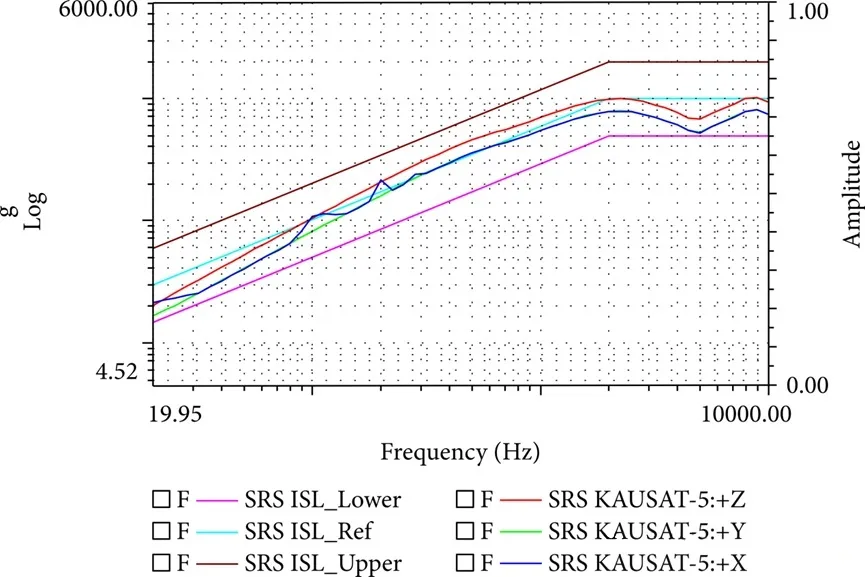
The shock test results for the x-axis of the qualification model are shown in the figure. After analyzing the SRS (Shock Response Spectrum) results, it was confirmed that the spectrum falls within the upper and lower reference limits provided by the launcher supplier, and the structure of the KAUSAT-5 satellite remained undamaged before and after the shock test.
Shock Test Results for the x-axis
The shock performance of the KAUSAT-5 FM (Flight Model) at the acceptance level was verified through analysis rather than physical shock testing, with the analysis results shown in Figure 21. After accounting for the damping effect in the P-POD, the overall trend of the SRS curve is similar to that of the physical shock test results. Consistent with the actual shock values, the maximum deformation is 3.9×10⁻⁷ m; even without considering the damping effect, there is no risk of structural damage. In addition, the maximum stress borne by the internal PCB bracket is 12.8 MPa, while the maximum yield stress of the component is approximately 500 MPa—with the stress accounting for only about 2% of the yield stress. Shock simulation of the flight model confirms that there is no risk of damage to the satellite.