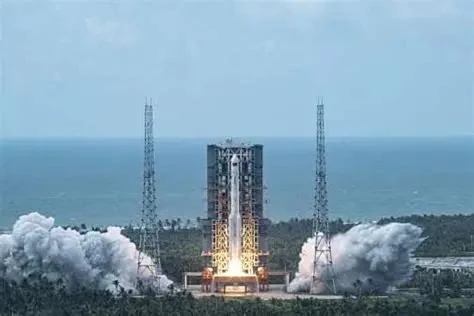
Due to differences in operating environments, the two types of launch sites face entirely distinct technical challenges in terms of launch platform structure, support systems, and control precision:

-
Offshore Platforms: The core challenge is "offsetting marine disturbance." Platforms must be equipped with "stabilization systems" (such as hydraulic anti-roll devices and mooring positioning systems) to prevent platform inclination caused by ocean waves (inclination must be < 0.5°; otherwise, the rocket is prone to instability). Meanwhile, platforms need to be lightweight (mostly modified cargo ships or semi-submersible platforms) to balance mobility and load-bearing capacity (required to support hundreds of tons of rocket + fuel).
-
Land Launch Sites: The core challenge is "long-term stability and load-bearing capacity." Launch pads are fixed concrete structures (up to 1-2 meters thick) with shock-resistant foundations at the bottom (to withstand the impact of high-temperature gas during rocket takeoff). They are also equipped with "deflector trenches" (to guide high-temperature gas away from the rocket body and avoid ablation) and fixed gantries (for vertical integration, testing, and fueling of rockets).
-
-
Offshore Platforms: An additional "dynamic reference" problem must be solved. During rocket launch, the platform slightly shakes with ocean waves. Therefore, the navigation system must real-time integrate "platform attitude data" (e.g., gyroscope, GPS positioning) and "rocket attitude data" to correct the launch reference (the reference for land launches is the fixed ground, while for offshore launches, it is a dynamic platform). This demands higher control precision (e.g., attitude measurement error must be < 0.1°).
-
Land Launch Sites: With a fixed ground reference, the navigation system only needs to focus on the rocket’s own attitude control, eliminating the need for additional correction of platform disturbance. The control logic is simpler and more mature.
-
-
Offshore Platforms: Support systems must be "miniaturized and integrated." Fuel refueling (e.g., liquid oxygen, kerosene) requires mobile tankers; test equipment must be resistant to salt spray corrosion (high salt content in the marine environment easily damages electronic devices); and marine emergency rescue vessels must be deployed (for personnel evacuation in case of launch failures).
-
Land Launch Sites: Support systems are "fixed and large-scale," including dedicated fuel storage depots, test workshops, command and control centers, and even supporting railways/highways (for rocket transportation). They can support the simultaneous integration and testing of multiple rockets, offering higher support efficiency.
Differences in technical design directly impact the two types of launch sites’ "orbital adaptability" and "safety and environmental requirements."