(a)
(b)
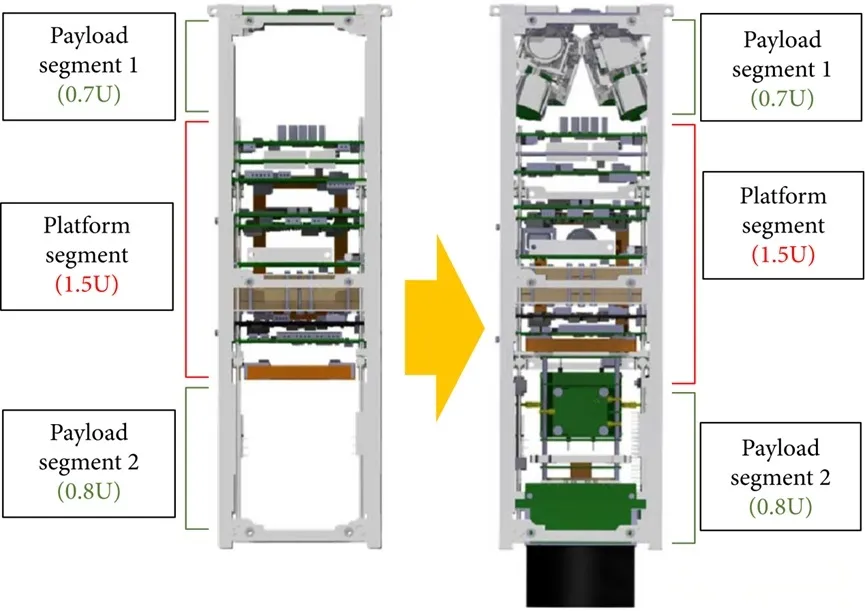
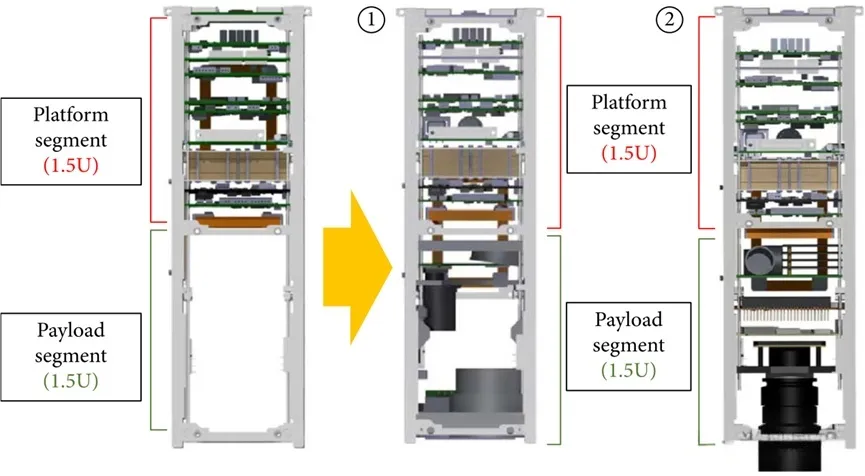
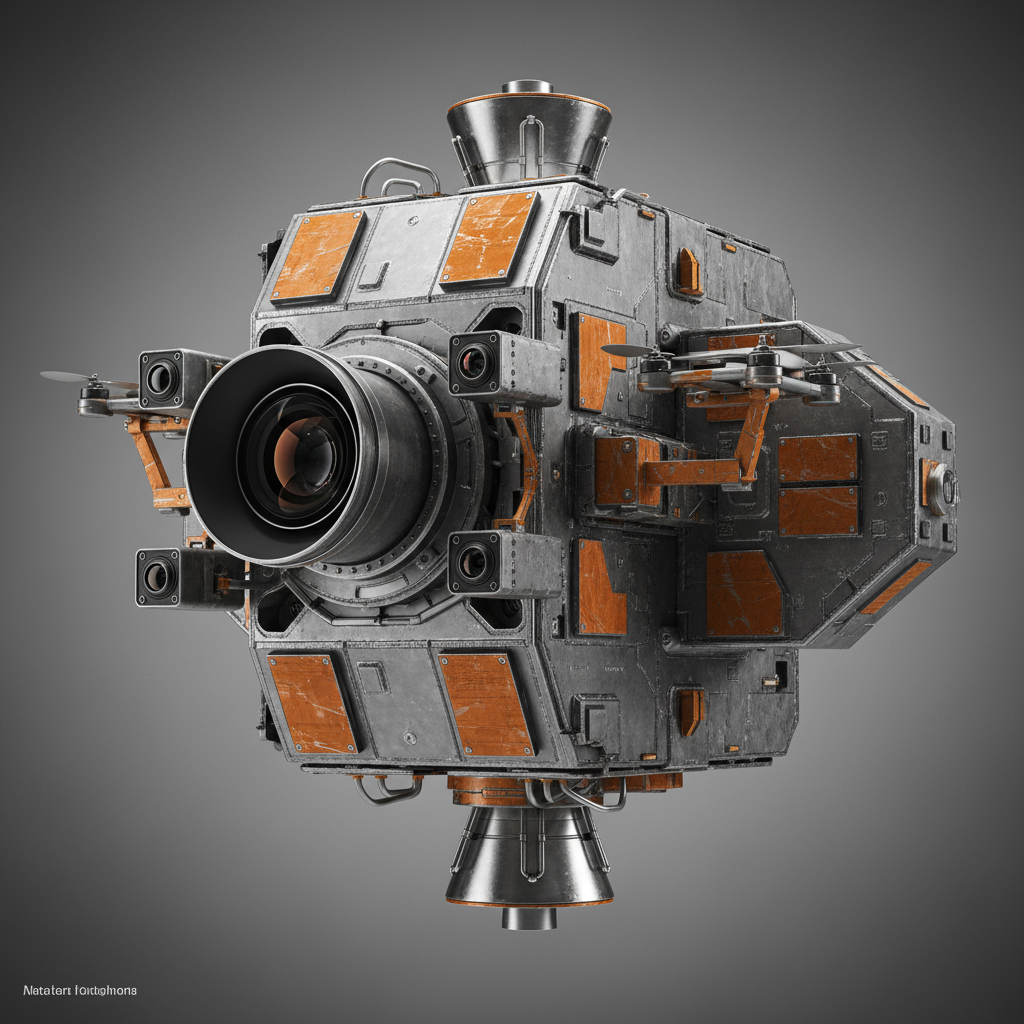
Figure 1 Comparison of the standard platform’s applications in KAUSAT-5 and other missions. (a) KAUSAT-5. (b) Other missions.
Figure 1(a) shows the structure, dimensions, and payload configuration of the KAUSAT-5 platform. The 3U CubeSat standard platform is not only applicable to KAUSAT-5 but also compatible with a variety of payloads, with application examples provided in Figure 1(b). Currently, the research team is designing a 3U CubeSat equipped with an EO (Electro-Optical) camera based on KAUSAT-5.
The configuration of the 3U CubeSat carrying an electro-optical camera can be designed with reference to the electro-optical camera requirements of two 3U CubeSats in Figure 1(b):
- Model ①: Adopts the optical camera module developed by TU Delft, with a resolution of 7.5m, a focal length of 40cm, and a volume of 1.5U. Due to its large volume, no additional actuators can be installed, which may lead to insufficient pointing accuracy, thereby affecting resolution and image quality and compromising mission success.
- Model ②: Adopts the optical camera module of GOM Space’s 3U CubeSat (NanoCam), with a resolution of 25m and a volume of 1U, but the lens barrel protrudes outward by approximately 30mm, occupying 0.7U. The advantage of using this EO payload is that attitude accuracy can be improved by adding a reaction wheel (with a volume of about 0.3U), and approximately 0.5U of volume remains after installation, which can be used to mount other mission equipment such as an Aircraft Tracking System (ADS-B) and a Vessel Tracking System (QubeAIS).
In summary, as long as the interface board between the optical camera and the platform meets the platform’s volume and mass requirements with minimal interface modifications, the camera can be installed and applied to the standard platform. In addition, by installing commercial kits and technology verification test platforms on the standard platform, the functions and performance of payloads can be verified in a space environment at low cost.
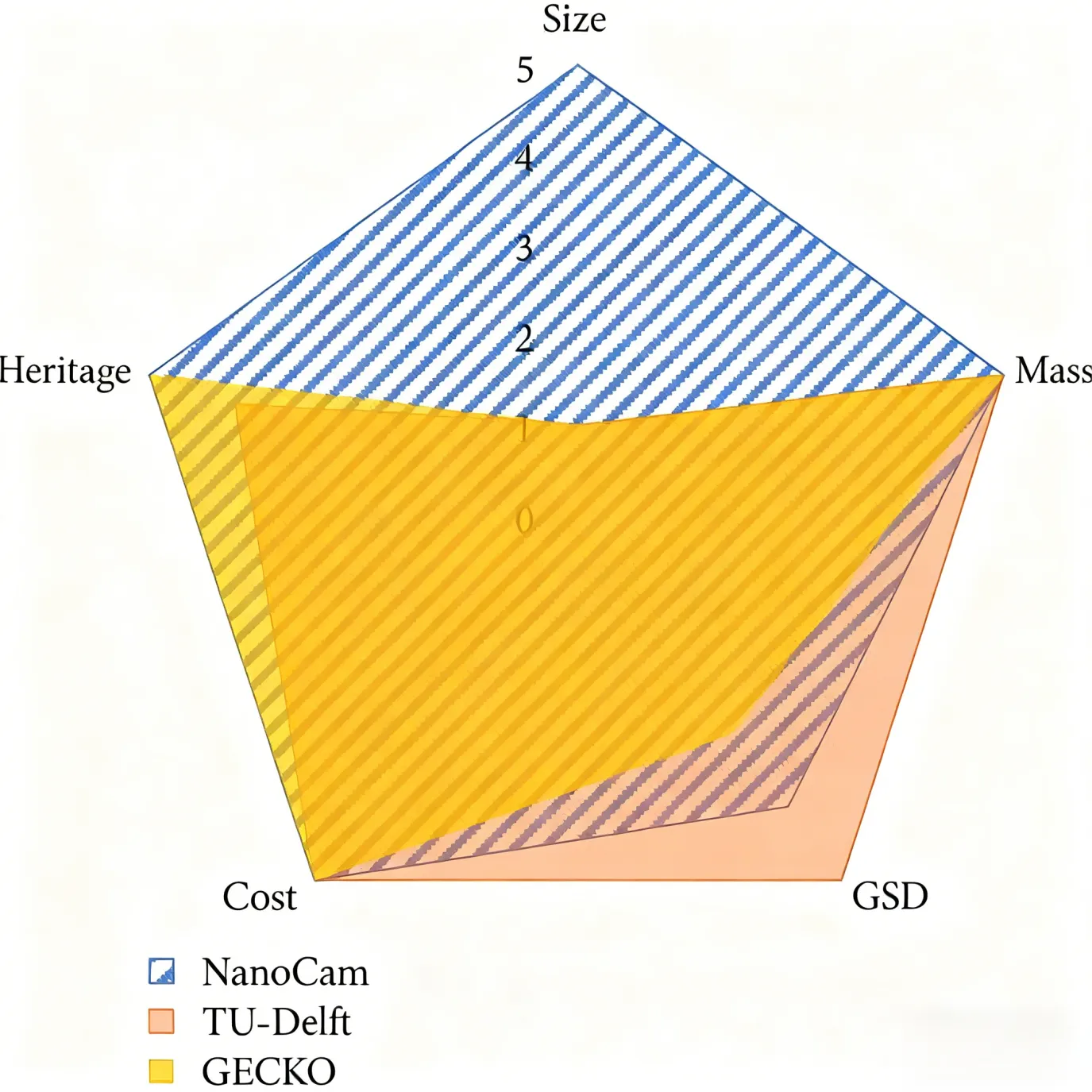
To design an adaptable camera, the research team conducted a multi-dimensional trade-off by investigating developed EO cameras and commercial products (Figure 2):
- 5 points are awarded if the camera and module size is less than 1U;
- 1 point is added for every 10m reduction in ground resolution below 20m;
- 5 points are awarded for having successful launch heritage;
- 5 points are awarded per 1U of mass.
Figure 2 Trade-off of EO camera characteristics for various 3U CubeSats.