- Afrikaans
- Albanian
- Amharic
- Arabic
- Armenian
- Azerbaijani
- Basque
- Belarusian
- Bengali
- Bosnian
- Bulgarian
- Catalan
- Cebuano
- China
- Corsican
- Croatian
- Czech
- Danish
- Dutch
- English
- Esperanto
- Estonian
- Finnish
- French
- Frisian
- Galician
- Georgian
- German
- Greek
- Gujarati
- Haitian Creole
- hausa
- hawaiian
- Hebrew
- Hindi
- Miao
- Hungarian
- Icelandic
- igbo
- Indonesian
- irish
- Italian
- Japanese
- Javanese
- Kannada
- kazakh
- Khmer
- Rwandese
- Korean
- Kurdish
- Kyrgyz
- Lao
- Latin
- Latvian
- Lithuanian
- Luxembourgish
- Macedonian
- Malgashi
- Malay
- Malayalam
- Maltese
- Maori
- Marathi
- Mongolian
- Myanmar
- Nepali
- Norwegian
- Norwegian
- Occitan
- Pashto
- Persian
- Polish
- Portuguese
- Punjabi
- Romanian
- Russian
- Samoan
- Scottish Gaelic
- Serbian
- Sesotho
- Shona
- Sindhi
- Sinhala
- Slovak
- Slovenian
- Somali
- Spanish
- Sundanese
- Swahili
- Swedish
- Tagalog
- Tajik
- Tamil
- Tatar
- Telugu
- Thai
- Turkish
- Turkmen
- Ukrainian
- Urdu
- Uighur
- Uzbek
- Vietnamese
- Welsh
- Bantu
- Yiddish
- Yoruba
- Zulu
Solar Wing: High-Efficiency, Lightweight Power Component
Advancing Energy Capture: The Critical Role of Solar Wing Technology
In an era defined by the imperative for sustainable energy and robust, autonomous systems, the solar wing stands as a cornerstone technology. These advanced photovoltaic arrays, often integrated with sophisticated deployment mechanisms, are pivotal for providing reliable power in diverse, challenging environments—from orbital spacecraft to high-altitude terrestrial platforms. Our focus here is to delve into the intricate details of this technology, emphasizing its manufacturing precision, operational capabilities, and transformative applications for B2B decision-makers and engineers. The underlying "folding and unfolding mechanism" is a critical component ensuring the reliable deployment and retraction of these vital energy-harvesting structures, particularly in missions demanding compactness during launch and expansive surface area once operational.
The demand for highly efficient and durable power solutions across sectors like aerospace, defense, and specialized industrial applications has propelled significant advancements in solar wing design. These systems are no longer merely flat panels but integrated assemblies of advanced materials, precision mechanics, and intelligent control systems, engineered to perform under extreme conditions, ensuring mission success and operational longevity.
Industry Trends & Market Dynamics for Advanced Solar Components
The global market for advanced solar components, particularly those designated for high-reliability applications, is experiencing exponential growth. Driven by the expansion of satellite constellations, the development of High-Altitude Platform Stations (HAPS), and the increasing need for autonomous power solutions in remote terrestrial locations, the demand for highly efficient and robust solar wing systems is unparalleled. Industry trends indicate a strong shift towards ultra-lightweight designs, enhanced power density per unit area, and increased resistance to environmental stressors such as radiation, thermal cycling, and micro-meteoroid impacts. Miniaturization, coupled with improved efficiency of photovoltaic cells (e.g., multi-junction solar cells achieving over 30% efficiency in space), is enabling smaller, more powerful platforms.
Furthermore, there's a growing emphasis on modularity and adaptability in wing solar component design, allowing for quicker integration into various platform architectures and facilitating easier maintenance or upgrades. This adaptability is critical for reducing time-to-market for new space-based assets and for ensuring long-term operational viability. Emerging markets in specialized defense applications and disaster response also contribute to the robust demand for resilient and rapidly deployable solar energy solutions.
Technical Specifications and Core Components
A sophisticated solar wing assembly comprises several critical components, each meticulously engineered for performance and reliability. At its heart are the photovoltaic cells, often multi-junction GaAs cells for space applications due to their high efficiency and radiation tolerance, or advanced monocrystalline silicon cells for terrestrial use. These cells are encapsulated within robust composite substrates, typically carbon fiber reinforced polymers (CFRP) due to their exceptional strength-to-weight ratio and thermal stability. The interconnects, often made of silver or copper, are designed to withstand extreme temperature fluctuations and mechanical stresses.
The deployment mechanism is paramount for functional integrity. This often includes intricate hinge systems, spring-loaded actuators, or motor-driven telescopic booms, all designed for precise, controlled unfolding and locking. Power conditioning units (PCUs) convert the raw solar energy into usable electrical power, ensuring stable voltage and current delivery to the payload. Thermal management systems are integrated to maintain optimal operating temperatures for the solar cells and electronic components, often utilizing specialized coatings or heat pipes.
Key Technical Parameters of a Typical High-Performance Solar Wing
| Parameter | Typical Specification (Space-Grade) | Description |
|---|---|---|
| Cell Type | Triple-Junction GaInP/GaAs/Ge | High-efficiency cells optimized for broad spectrum absorption and radiation tolerance. |
| Beginning-of-Life (BOL) Efficiency | >30% (AM0, 28°C) | Efficiency under space solar spectrum at standard operating temperature. |
| Power Density (Stowed) | >150 W/kg | Power generated per unit mass of the stowed array, critical for launch vehicles. |
| Power Density (Deployed) | >250 W/m² | Power output per unit area of the deployed array. |
| Operating Temperature Range | -120°C to +100°C | Ensures functionality across extreme thermal cycling. |
| Deployment Time | Typically 3-5 minutes (full deployment) | Time required for the array to fully extend post-launch. |
| Service Life | 10-15 years (LEO/GEO equivalent) | Expected operational lifetime in specified orbital environments. |
| Radiation Hardness (EOL Degradation) | <20% over 15 years | Maximum power degradation at End-of-Life due to radiation exposure. |
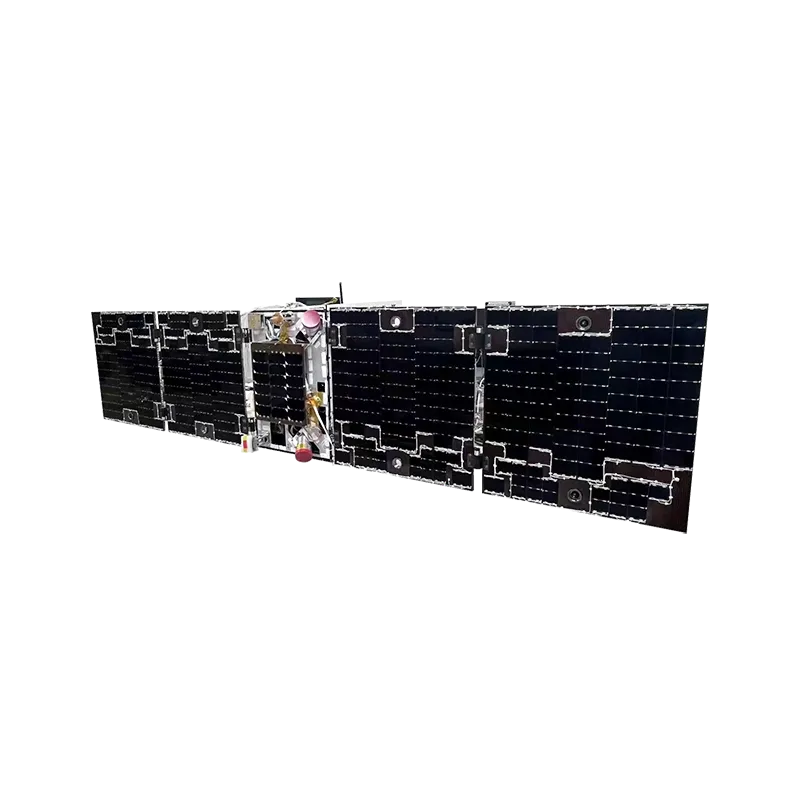
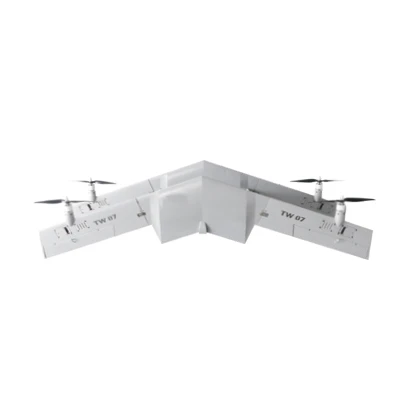
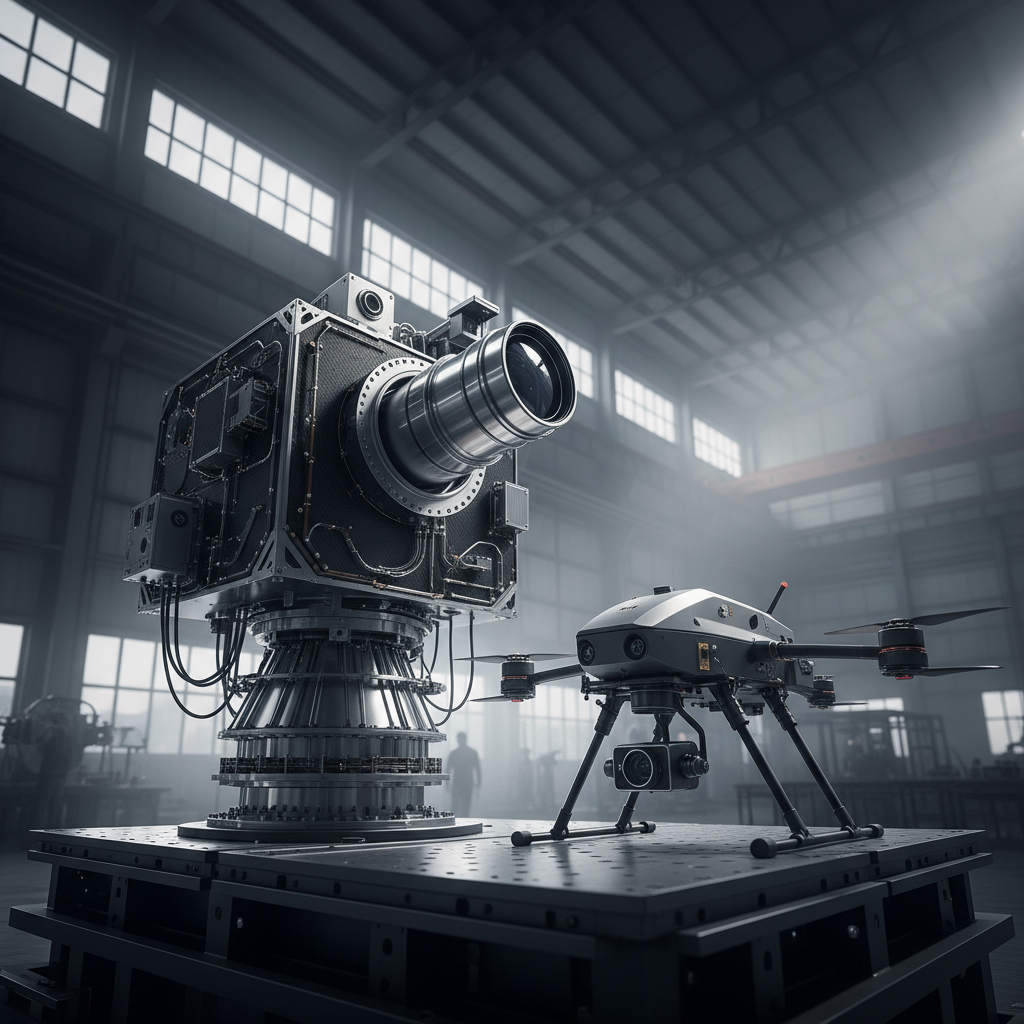
Figure 1: Illustration of a precision-engineered solar wing deployment mechanism for satellite applications.
Precision Manufacturing Process Flow of a Solar Wing
The fabrication of a high-performance solar wing is a multi-stage process demanding exceptional precision, adherence to stringent quality control, and the integration of advanced manufacturing techniques. This process ensures the component's ability to withstand the harsh conditions of its intended operational environment.
Process Flow Stages:
- 1. Materials Selection and Preparation: This initial phase involves selecting specialized materials. For the substrate and structural elements, aerospace-grade carbon fiber reinforced polymers (CFRP) or high-strength aluminum alloys (e.g., 6061-T6, 7075-T6) are chosen for their superior strength-to-weight ratio and thermal stability. Photovoltaic cells (e.g., multi-junction GaAs cells) are sourced from certified suppliers, meeting strict efficiency and radiation hardness specifications. Adhesives and encapsulants are selected for their thermal cycling resistance and outgassing properties.
- 2. Structural Component Manufacturing: Structural elements for the wing solar framework, including booms, panels, and hinge mechanisms, are fabricated. Techniques like CNC machining are employed for precise shaping of metal components, while advanced composite lay-up and curing (e.g., autoclave processing) are used for CFRP panels, ensuring structural integrity and minimal mass. Casting and forging might be used for specific load-bearing brackets requiring high mechanical properties.
- 3. Photovoltaic Cell Integration: Individual solar cells undergo visual inspection and electrical performance testing. They are then precisely bonded onto the composite substrates using specialized, space-qualified adhesives. Interconnects are carefully welded or soldered, ensuring robust electrical connections capable of enduring extreme thermal variations and vibrations.
- 4. Assembly & Wiring Harness Integration: The individual photovoltaic panels are assembled onto the structural framework, often incorporating the folding and unfolding mechanism. The complex wiring harnesses, designed to deliver power from the array to the spacecraft bus, are carefully integrated, ensuring redundancy and protection against environmental factors. This stage is critical for the overall functionality of the solar wing component.
-
5. Functional Testing & Qualification: Post-assembly, the solar wing undergoes rigorous testing to validate its performance and durability.
- Thermal Vacuum (TVAC) Testing: Simulates the vacuum and extreme temperature cycles of space, verifying material integrity and electrical performance.
- Vibration and Acoustic Testing: Mimics launch loads, ensuring mechanical robustness (e.g., MIL-STD-810G, ECSS-E-ST-10-03C).
- Solar Simulation & Electrical Performance Testing: Measures power output under simulated solar irradiance (e.g., AM0 spectrum) to confirm BOL efficiency.
- Deployment Testing: Verifies the reliable and repeatable operation of the folding and unfolding mechanism in a simulated zero-G environment.
- EMI/EMC Testing: Ensures electromagnetic compatibility with other spacecraft systems.
- 6. Final Inspection & Certification: A thorough final inspection is conducted before packaging. All manufacturing and test data are documented, and compliance with all contractual and regulatory standards (e.g., ISO 9001, AS9100) is certified.
Target industries include petrochemical (for remote monitoring stations requiring autonomous power), metallurgy (for robust power in harsh industrial environments), and particularly water supply & drainage (for powering sensors, pumps, and remote control systems). In such scenarios, the advanced corrosion resistance of selected materials and the energy-saving capabilities of high-efficiency cells demonstrate significant advantages, providing reliable power infrastructure where grid access is impractical or cost-prohibitive.
Application Scenarios & Technical Advantages
The versatility and robust performance of advanced solar wing components make them indispensable across a spectrum of demanding applications. Their primary role is in providing reliable, long-duration electrical power where conventional sources are unavailable or impractical.
Key Application Areas:
- Satellite & Spacecraft Power Systems: This is the most prominent application. From Low Earth Orbit (LEO) constellations for telecommunications and Earth observation to Geostationary Orbit (GEO) weather satellites and deep-space probes, solar wing arrays are the primary energy source. Their ability to deploy efficiently from a compact launch configuration and generate substantial power in the vacuum of space is critical.
- High-Altitude Platform Stations (HAPS): These unmanned aerial vehicles (UAVs) or stratospheric airships operate for extended periods, providing persistent surveillance, communication relay, or environmental monitoring. They rely heavily on large-area, lightweight wing solar components to gather energy during the day and power themselves through the night.
- Remote Terrestrial Infrastructure: For applications in extreme or isolated environments, such as offshore oil and gas platforms, remote scientific research stations, critical defense outposts, and monitoring equipment for pipelines in the petrochemical industry, robust solar solutions are vital. Here, the corrosion resistance of materials and resilience to harsh weather conditions are key technical advantages.
- Autonomous Robotics & UAVs: For long-endurance autonomous systems, particularly in surveillance, agriculture, or environmental monitoring, compact and efficient solar wing solutions extend operational time significantly, reducing the need for frequent recharging.
Technical Advantages:
- High Power-to-Weight Ratio: Essential for space and aerial applications where every gram impacts mission cost and performance. Advanced composites and high-efficiency cells contribute significantly to this.
- Exceptional Durability & Reliability: Engineered to withstand extreme thermal cycling, radiation exposure, micro-meteoroid impacts, and mechanical vibrations, ensuring long operational lifetimes.
- Compact Stowage & Reliable Deployment: The folding and unfolding mechanism is a testament to precision engineering, allowing large arrays to be stowed in minimal volumes during launch and deployed flawlessly in orbit.
- Energy Efficiency: Utilization of multi-junction solar cells and optimized array designs maximize energy capture from available solar irradiance, leading to significant energy savings and reduced reliance on auxiliary power.
- Corrosion Resistance: For terrestrial and marine applications, materials and coatings are selected to resist environmental degradation, providing extended service life in harsh chemical or saline environments. This is particularly beneficial for the solar wing use in industries like water supply & drainage.
Vendor Comparison and Customized Solutions
Selecting the right vendor for solar wing components is a critical decision for any B2B project, heavily influencing system performance, reliability, and project timelines. While specific vendors offer varying specializations, a comparative analysis often focuses on key differentiators such as technological expertise, manufacturing capabilities, certifications, and post-sales support.
Key Differentiators in Solar Wing Component Providers:
| Category | Vendor A (Specialized Aerospace) | Vendor B (Broad Industrial) | Vendor C (Emerging Technologies) |
|---|---|---|---|
| Primary Focus | GEO/LEO Satellites, Deep Space Probes | Remote Industrial, HAPS, UAVs | Flexible Arrays, Ultra-lightweight Concepts |
| Cell Technology Expertise | Multi-junction GaAs (30%+) | High-efficiency Monocrystalline Si (22%+) | Perovskite, Thin-film (flexible, 18%+) |
| Manufacturing Certifications | AS9100D, ISO 9001, ECSS Compliant | ISO 9001, CE, RoHS | ISO 9001 (pending AS9100) |
| Deployment Mechanism Specialization | High-reliability motor-driven booms, precision hinges | Spring-loaded, robust for frequent cycles | Rollable/retractable systems |
| Customization Capability | Extensive (full system design, niche materials) | Moderate (panel sizing, power output) | High (novel form factors, cell integration) |
| Typical Lead Time (Custom Order) | 12-24 months | 6-12 months | 9-18 months |
Customized Solutions: Tailoring Your Solar Wing
Given the highly specialized nature of applications requiring robust solar wing technology, off-the-shelf solutions are rarely sufficient. Customization is often essential to meet specific mission parameters and environmental challenges. A reputable provider will offer comprehensive design and engineering services to tailor the solar wing to precise requirements.
- Power Output & Voltage Matching: Designing arrays to achieve specific power levels (e.g., 500W to 10kW+) and voltage outputs compatible with the host system's power bus.
- Form Factor & Stowage Volume Optimization: Customizing panel dimensions, hinge configurations, and deployment mechanisms to fit within strict launch vehicle envelopes or platform constraints.
- Environmental Hardening: Selecting materials and coatings specifically for radiation exposure (space), extreme temperatures (planetary probes), or corrosive atmospheres (terrestrial industrial sites).
- Integrated Sensors & Actuators: Incorporating sun tracking sensors, position feedback mechanisms for deployment, and thermal sensors for monitoring array health.
- Lifetime & Degradation Planning: Engineering the array for a specific operational lifespan, accounting for expected degradation due to radiation, thermal cycling, or material aging.
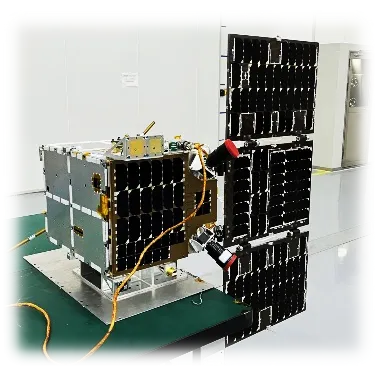
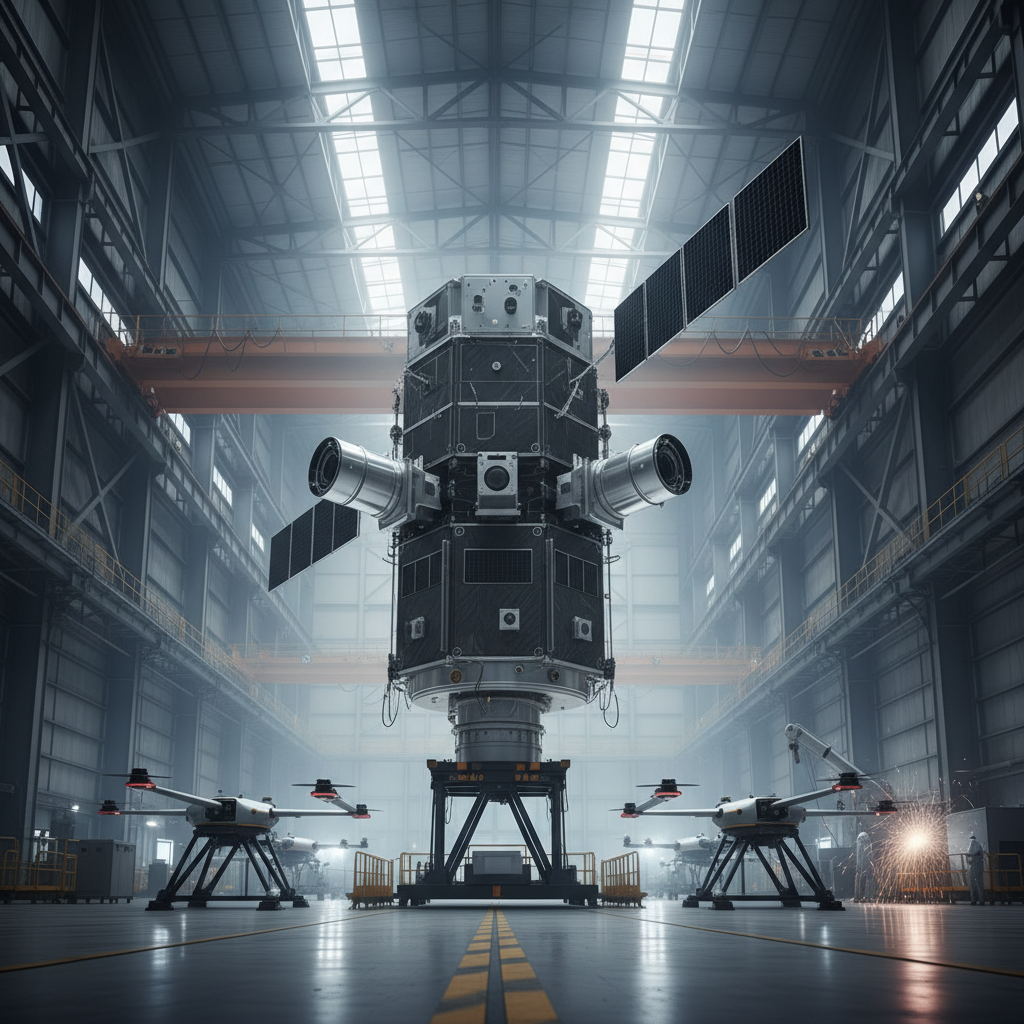
Figure 2: A deployed wing solar array, showcasing its expansive surface for optimal energy capture.
Application Case Studies & Client Successes
Real-world deployments underscore the reliability and effectiveness of meticulously engineered solar wing solutions. Our experience spans multiple critical missions, demonstrating sustained performance and client satisfaction.
Case Study 1: LEO Satellite Constellation Power
A leading satellite communications provider required a compact, high-power-density wing solar array for a constellation of 50 LEO satellites. Challenges included extreme thermal cycling, radiation exposure, and the need for highly reliable automated deployment.
- Solution: Developed a custom 4-panel solar array with triple-junction GaAs cells, integrated with a proprietary folding and unfolding mechanism designed for 5,000 thermal cycles.
- Outcome: All 50 satellites successfully deployed their arrays with 100% reliability. The arrays consistently provided 2.5 kW BOL power, enabling robust data transmission for over 7 years to date, exceeding the initial 5-year mission lifespan by 40%. Client feedback highlighted the exceptional resilience to space environment degradation.
Case Study 2: Autonomous Petrochemical Pipeline Monitoring
A major petrochemical firm needed an autonomous power source for a network of remote pipeline monitoring sensors in a highly corrosive desert environment, requiring minimal maintenance for 10+ years.
- Solution: Engineered a robust, ground-based solar wing component, utilizing monocrystalline silicon cells encapsulated with enhanced UV and corrosion-resistant polymers. The structural components were fabricated from marine-grade aluminum and coated with a specialized anti-corrosion layer.
- Outcome: The systems have operated continuously for 8 years without failure, providing consistent power to critical sensors. The client reported a 60% reduction in operational expenditure previously allocated to battery replacements and grid infrastructure expansion. The superior material choice ensured the longevity of the solar wing despite the harsh climate.
Trustworthiness, Support, and FAQ
Certifications & Authoritative References:
Our commitment to quality is underpinned by adherence to international standards and rigorous internal protocols. We are ISO 9001:2015 certified for quality management systems and AS9100D certified for aerospace quality standards. Our products undergo validation against relevant ECSS (European Cooperation for Space Standardization) standards, including ECSS-Q-ST-70 (Materials, Processes, and Components) and ECSS-E-ST-10-03C (Testing). Our test facilities are equipped to perform MIL-STD-810G environmental testing. With over 20 years of experience in high-reliability component manufacturing, we have partnered with leading aerospace agencies and defense contractors globally.
Lead Time & Fulfillment:
For standard solar wing components, lead times typically range from 8-12 weeks, depending on component complexity and order volume. Custom-engineered solutions, requiring detailed design, prototyping, and extensive qualification, generally have a lead time of 6-18 months. We maintain transparent communication throughout the project lifecycle, providing regular updates on manufacturing progress and delivery schedules.
Warranty Commitments:
All our solar wing components come with a standard 5-year warranty covering manufacturing defects and material failures under specified operating conditions. Extended warranty options and performance guarantees, tailored to specific mission profiles and environmental exposures, are available upon request for critical applications.
Customer Support:
Our dedicated technical support team comprises experienced engineers available for consultation, integration assistance, and post-deployment support. We offer 24/7 emergency support for critical missions and provide comprehensive documentation, including detailed manuals, performance data, and component lifecycle analyses.
Frequently Asked Questions (FAQ):
-
Q1: What is the typical operational lifespan of your solar wing components?
A1: Our components are engineered for a minimum operational lifespan of 10-15 years for space applications (LEO/GEO equivalent) and 15-20 years for terrestrial applications, depending on environmental conditions and specific design. -
Q2: Can your solar wing arrays be customized for specific power outputs or form factors?
A2: Absolutely. Customization is a core part of our offering. We work closely with clients to design arrays that meet precise power requirements, physical dimensions, deployment kinematics, and environmental specifications. -
Q3: What testing standards do your products adhere to?
A3: Our products comply with international standards such as ISO 9001:2015, AS9100D, and relevant ECSS standards (e.g., ECSS-Q-ST-70, ECSS-E-ST-10-03C) for space applications. Terrestrial applications meet industry standards for environmental resilience (e.g., specific NEMA ratings for enclosure, MIL-STD-810G for environmental robustness). -
Q4: How do you ensure the reliability of the folding and unfolding mechanism?
A4: The mechanism undergoes extensive qualification testing, including hundreds of deployment cycles in thermal vacuum chambers, vibration testing, and shock tests. Materials are selected for their long-term stability and resilience, ensuring flawless operation even after prolonged stowed periods.
Conclusion
The advanced solar wing is far more than a simple energy generator; it represents a fusion of cutting-edge materials science, precision engineering, and robust systems integration. Its critical role in powering everything from sophisticated spacecraft to vital terrestrial infrastructure underscores the necessity for unparalleled reliability, efficiency, and adaptability. As global demand for autonomous, sustainable power solutions continues to escalate, the innovation in solar wing technology will remain at the forefront, driving progress across numerous high-stakes industries. Partnering with a specialist in this domain ensures access to the expertise and proven solutions essential for mission success and long-term operational resilience.
References:
- European Cooperation for Space Standardization. ECSS-E-ST-10-03C Rev. 1, Space engineering – Testing. ESA Publications Division, 2012.
- International Organization for Standardization. ISO 9001:2015, Quality management systems – Requirements. ISO, 2015.
- SAE International. AS9100D, Quality Management Systems – Requirements for Aviation, Space, and Defense Organizations. SAE International, 2016.
- National Renewable Energy Laboratory. "Solar Cell Efficiency Tables." NREL, Various Years.
- Jet Propulsion Laboratory. "Spacecraft Power Systems." NASA Technical Report, Various Publications.