- Afrikaans
- Albanian
- Amharic
- Arabic
- Armenian
- Azerbaijani
- Basque
- Belarusian
- Bengali
- Bosnian
- Bulgarian
- Catalan
- Cebuano
- China
- Corsican
- Croatian
- Czech
- Danish
- Dutch
- English
- Esperanto
- Estonian
- Finnish
- French
- Frisian
- Galician
- Georgian
- German
- Greek
- Gujarati
- Haitian Creole
- hausa
- hawaiian
- Hebrew
- Hindi
- Miao
- Hungarian
- Icelandic
- igbo
- Indonesian
- irish
- Italian
- Japanese
- Javanese
- Kannada
- kazakh
- Khmer
- Rwandese
- Korean
- Kurdish
- Kyrgyz
- Lao
- Latin
- Latvian
- Lithuanian
- Luxembourgish
- Macedonian
- Malgashi
- Malay
- Malayalam
- Maltese
- Maori
- Marathi
- Mongolian
- Myanmar
- Nepali
- Norwegian
- Norwegian
- Occitan
- Pashto
- Persian
- Polish
- Portuguese
- Punjabi
- Romanian
- Russian
- Samoan
- Scottish Gaelic
- Serbian
- Sesotho
- Shona
- Sindhi
- Sinhala
- Slovak
- Slovenian
- Somali
- Spanish
- Sundanese
- Swahili
- Swedish
- Tagalog
- Tajik
- Tamil
- Tatar
- Telugu
- Thai
- Turkish
- Turkmen
- Ukrainian
- Urdu
- Uighur
- Uzbek
- Vietnamese
- Welsh
- Bantu
- Yiddish
- Yoruba
- Zulu
Visual Navigation Technologies in Rocket Recovery
1. Overview
The entire rocket recovery process is divided into several phases, each with different priorities in guidance technology.
(1) Guidance Technology in the Recovery Trajectory Correction Phase
During this phase, the rocket must precisely adjust its attitude and orbit to stay on the pre-planned trajectory.
An inertial navigation system (INS) combined with a satellite navigation system is typically used to obtain critical information such as position and velocity. Based on this data, the guidance system plans an optimal correction trajectory and gradually steers the rocket into the designated recovery corridor by controlling engine thrust vectoring and aerodynamic control surfaces.
(2) Guidance Technology in the Aerodynamic Deceleration Phase
The focus here is on deceleration and attitude stabilization using the rocket’s aerodynamic shape and control components such as grid fins under aerodynamic drag.
The guidance system calculates and controls attitude angles — including angle of attack and sideslip angle — based on real-time flight conditions such as atmospheric density, wind speed, and wind direction. By adjusting these angles, the rocket achieves effective deceleration while maintaining stable flight, avoiding tumbling or loss of control caused by aerodynamic instability.
(3) Guidance Technology in the Recovery and Landing Phase
The landing phase is the most critical stage of rocket recovery.
In this phase, the rocket uses multiple sensors — including LiDAR, vision cameras, and microwave radar — to accurately measure its relative position, velocity, and attitude with respect to the landing site.
Using advanced trajectory-planning algorithms such as model predictive control (MPC), the guidance system generates an optimal landing trajectory from the current position to the landing point, taking into account remaining thrust, vehicle mass, aerodynamic drag, and terrain.
Soft landing is achieved by precisely controlling engine thrust magnitude and direction, supported by the shock absorption mechanism of the landing legs.
2. Visual Navigation Technology in the Recovery and Landing Phase
Current navigation solutions for reusable rocket descent are mostly integrated navigation systems centered on inertial navigation, supplemented by auxiliary navigation equipment such as DGPS/INS, air data systems, and radar altimeters.
During descent, the rocket operates in a rapidly changing environment. Issues such as airframe vibration, aero-optical effects, and satellite signal outages cause different navigation devices to function only during limited periods and introduce errors.
For example, GPS positioning errors include:
- Systematic errors: ephemeris error, satellite clock bias, receiver clock bias, antenna phase center error, relativistic effects
- Random errors: multipath effects, ionospheric and tropospheric refraction, tides, and loading tides
These errors inevitably degrade relative position estimation. To meet the strict reliability requirements of vertical landing for reusable rockets, new technical approaches are needed to provide navigation redundancy in case of sensor failure, enabling accurate estimation of the rocket’s pose relative to the designated landing platform.
Visual navigation technology offers high navigation accuracy in the final landing stage of reusable rocket recovery, at a lower cost compared to precision equipment such as GPS, inertial navigation systems, and altimeters.
However, applying visual navigation during rocket recovery requires real-time imaging of ground targets. Due to the rocket’s shape and sensor installation constraints, a single vision sensor cannot capture complete target imagery.
In addition, the rocket’s high flight speed and strict constraints on on-board computing power, power consumption, volume, and weight require algorithms to be fast, real-time, and implementable on-board.
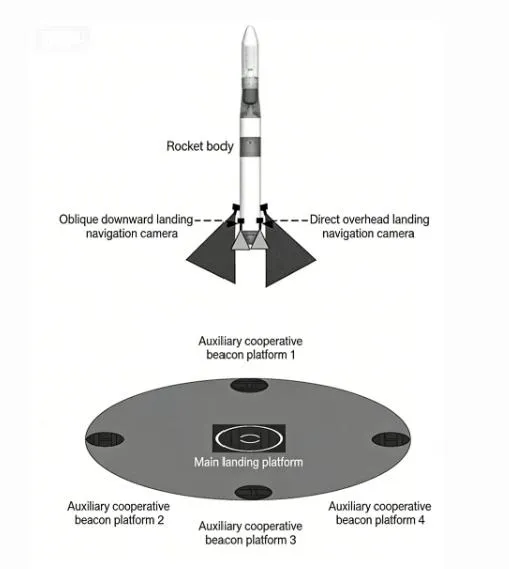
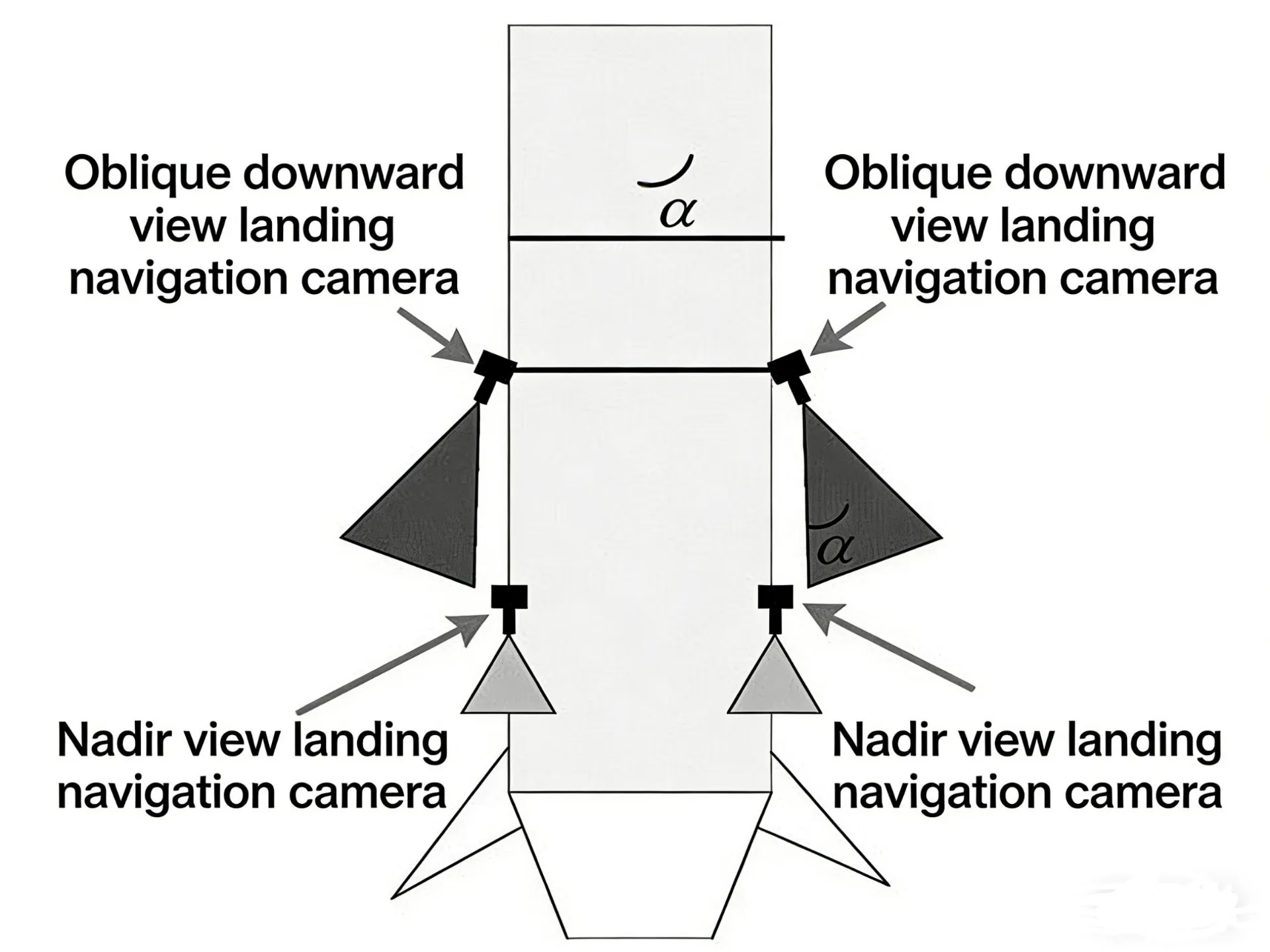
A vision-aided guidance system typically includes:
- Landing navigation cameras mounted on the rocket
- Landing platforms deployed on land or sea
- A real-time estimation module for the rocket’s position and attitude deviation relative to the main landing platform
Specifically:
- The landing navigation camera suite includes 4 oblique downward-looking cameras and 2 front downward-looking cameras.
- The landing system consists of 1 main landing platform and 4 auxiliary cooperative beacon platforms.
When the rocket is 10 km to 100 m above the main landing platform, the on-board cameras image the main platform and auxiliary beacons.
The real-time estimation module calculates the rocket’s position and attitude deviation relative to the landing platform based on the imagery. These deviations are used to control the accuracy of the rocket’s vertical landing.
3. Visual Alignment Markers on Recovery Ships