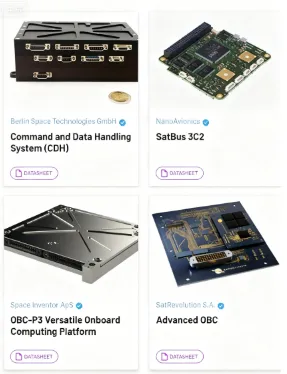
The On-Board Computer (OBC) is the "brain" of a satellite, and its selection directly determines the satellite’s reliability, mission execution capability, and cost. Through the analysis of 11 criteria including "orbit characteristics, mission duration, and power requirements," the core logic of OBC selection can be refined: taking "mission objectives" as the core, "environmental constraints" as the boundary, and balancing "reliability, cost, and development cycle."
First, determine the satellite’s "orbit type" (LEO/MEO/GEO) and "mission duration" (short-term/long-term), which are the "hard constraints" for OBC selection:
- For "short-term LEO missions (<2 years)": Lock in OBCs with "COTS components + basic interfaces + lightweight design" (e.g., NANOSATPRO) to control costs;
- For "long-term GEO missions (>5 years)": Lock in OBCs with "radiation-hardened components + high-end interfaces (SpaceWire/CAN) + robust design" to ensure service life.
-
Within the scope of hard constraints, further match core requirements such as "power, weight, computing power, interfaces, memory, and sensors":
- Power: Prioritize OBCs with "flash FPGA + dynamic power adjustment" to balance low power consumption and high computing power;
- Weight and Size: Select OBCs with corresponding weight (100–500g) and size based on the satellite platform (nanosatellite/microsatellite) to avoid exceeding the satellite’s payload limits;
- Computing Power and Memory: Derive computing power requirements from "per-orbit data volume + communication window" and memory requirements from "software scale + data storage" to avoid excessive computing power or insufficient memory;
- Interfaces and Sensors: Match interface types (high-speed/basic/dedicated) according to sensor categories (mission-critical/system health/navigation and positioning) to ensure smooth data acquisition and processing.
Verify OBC reliability through "compliance testing" and "space heritage":
- Compliance Testing: Ensure the OBC has passed a full set of tests including TVAC, vibration, radiation, and EMI/EMC to adapt to the space environment;
- Space Heritage: Prioritize OBCs with "≥3 on-orbit missions and ≥2 years of fault-free operation," with particular attention to heritage cases matching the current mission’s orbit and type.
-
Finally, make the final decision based on "supplier technical support" and "delivery cycle":
- Technical Support: Select suppliers that provide "driver software, compatibility testing, and troubleshooting" to reduce independent R&D workload;
- Delivery Cycle: Ensure the OBC’s delivery time aligns with the overall satellite development schedule to avoid launch delays caused by OBC shortages.
-
Selection Direction: NANOSATPRO-class OBC (100g, 95×90×18mm) with COTS components + basic interfaces (UART/SPI/I2C), EDAC-equipped RAM (512MB), flash memory (8GB), passed LEO-grade radiation testing (TID ≥30krad), and has ≥2 LEO on-orbit experiences.
Selection Direction: Radiation-hardened OBC (weight 500–1000g) with Rad-Hard processor + flash FPGA, high-end interfaces (SpaceWire/CAN), EDAC-equipped RAM (4GB), radiation-hardened flash memory (128GB), passed GEO-grade radiation testing (TID ≥100krad), and has ≥5 GEO on-orbit experiences.
OBC selection is not about "pursuing extreme parameters" but "matching on demand" – behind each criterion lies the reflection of satellite mission objectives and space environmental constraints. Only by systematically evaluating the 11 criteria around "mission requirements" can we select an OBC that is "reliable, efficient, and cost-effective," laying a solid foundation for the success of the satellite mission.
- Term Consistency: Maintains uniform translation of core terms throughout the series (e.g., "Compliance test" → "compliance testing", "Aerospace heritage" → "space heritage", "Radiation-resistant reinforcement" → "radiation-hardened", EDAC/Rad-Hard retained as industry-standard abbreviations);
- Logical Cohesion: Uses transition words (e.g., "First", "Within the scope", "Finally") to clarify the step-by-step logic of the framework, ensuring readability of technical decision-making processes;
- Precision of Quantitative Indicators: Accurately translates dimensions, weights, and performance parameters (e.g., "95×90×18mm", "100–500g", "TID ≥30krad") to meet technical documentation standards;
- Scenario Adaptation: Retains model names (e.g., NANOSATPRO) and interface specifications (UART/SPI/SpaceWire) as used in the original text, with parenthetical explanations for platform-specific terms (e.g., "nanosatellite/microsatellite") to enhance international understanding;
- Conciseness of Core Arguments: Condenses the concluding thesis ("On demand matching" → "matching on demand") into a concise, impactful expression that captures the essence of the entire guide while adhering to academic writing conventions.